
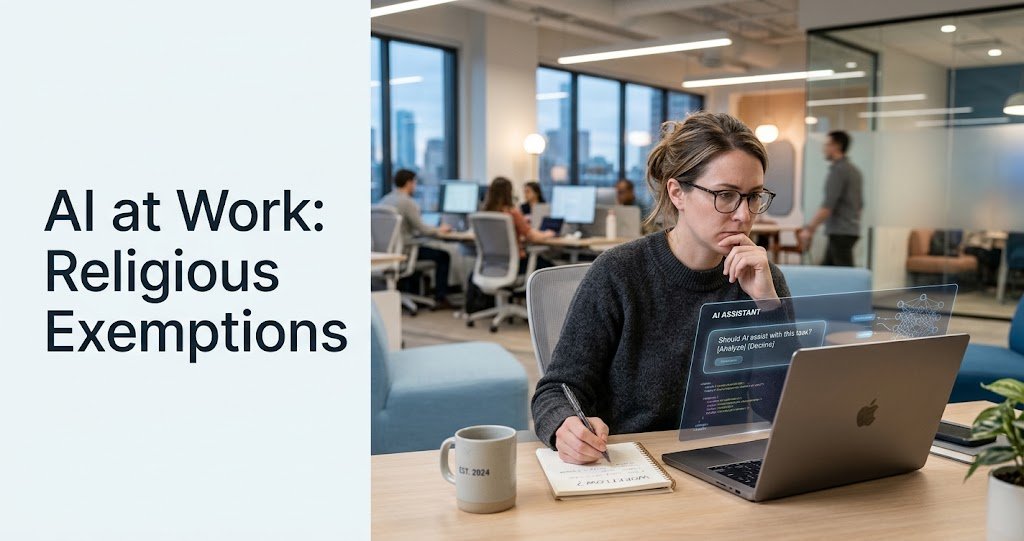
Introduction: Religious Exemption From Using AI at Work
Artificial intelligence is changing how we work in many workplaces across the United States. Organizations are using new AI applications to generate reports, analyze data, monitor projects, produce content, and boost productivity.
Some employees are on board, but others are wondering if they should be compelled to use artificial intelligence at work.
A recent incident involving an employee at the University of Kentucky has raised a rather atypical dilemma: Is a person who doesn’t believe in God eligible for a religious exemption to using AI at work?
David Durman, a university administrator and nontheistic Humanist, received an accommodation that enables him to fulfill his job duties without having to use artificial intelligence himself. His employer’s accommodations are an example of how American workplace protections might extend to some deeply held nontraditional beliefs.
The move also leaves other issues in the future of work in the United States. Starting with employee rights and artificial intelligence policies, to human creativity.
UK Employee Granted AI Workplace Exemption
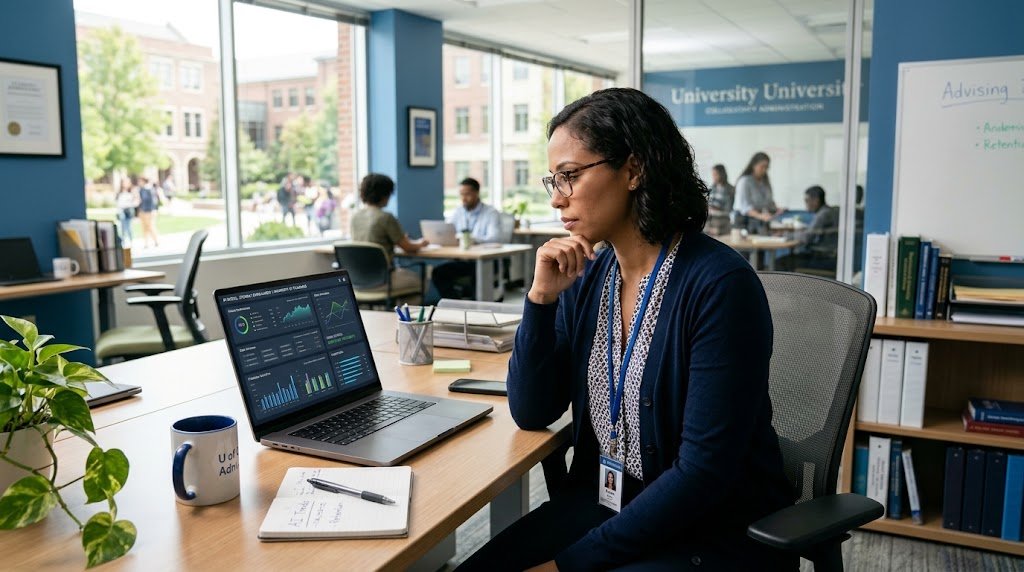
David Durman is at the University of Kentucky,y where he assists researchers in applying for grant funding. His management duties are inherently reducible without the need for personally relying on artificial intelligence.
But as the use of these tools became more prevalent in the workplace, Durman began to fear that it would one day be both expected and required to use them.
He thinks too much dependence on AI might impair people’s capacity to think critically, moralize,e or be accountable for their actions.
These issues, for Durman, are linked to his Humanist perspective. He believes that the use of the human mind independently and in a proactive manner is vital for individual welfare and social good.
He decided to pursue his other options and reached out to the AHA to seek help in finding accommodation at work.
The UK also considered his application and agreed to a plan that let him carry out his core job function by putting the AI to use on his behalf.
The ruling made headlines as it illustrates the changing manner in which workplace accommodation conversations are happening with the increased incorporation of artificial intelligence in our daily jobs.
How Can a Religious Exemption Be Obtained Without Believing in God?

However, in the US workplace, protection by religion laws can mean protecting nontraditional religious beliefs and belief in a supernatural being.
Title VII of the Civil Rights Act of 1964 requires most covered employers to reasonably accommodate an employee’s sincerely held religious beliefs and practices, unless doing so would impose an undue hardship on the business.
According to the EEOC, religious beliefs “can include beliefs that are both moral or ethical in nature and truly held, even if they are not part of a traditional religious doctrine.”
This is significant in Durman’s case, in that Humanism offers a more than sufficient moral system based on human progress, reason, and responsibility without the assumption of God.
That said, not every opinion, position, or preference can be a religion. The belief has to be a genuine religion and a true belief.
Durman’s case demonstrates the importance of employers going beyond traditional religion when assessing such requests.
What Is Humanism? And How Is It At Odds With Use Of AI For Durman?
Humanism is a philosophical approach that asserts a human duty and capacity to be accountable and rational, and to promote the well-being of human beings.
Nontheistic Humanists, on the whole, do not turn to belief in a god, or any form of supernatural authority, as a basis for their moral principles. They instead turn to human experience and thinking and their obligations toward their fellow humans.
Durman says that AI may hinder the formation and use of independent human judgment when people place too much value on it.
He is also concerned with the impact of AI on jobs, the environment, and creativity.
These issues are part of the broader debate in the US about the role of artificial intelligence in education, business, government, and the arts.
I think one thing that should be clarified is that Humanism is not the Scrooge that opposes AI. Durman’s dislike for it is his personal view, not the consensus of Humanists.
Why Are Some American Workers Concerned About AI?

As more and more companies adopt AI, concerns are surfacing among workers in various sectors.
Another worry is the impact AI has on critical thinking. Generative AI tools can generate written content, complete summaries of documents, provide answers to questions, and do research. But some workers are concerned that reliance on such technology may hamper their ability to build analytical and problem-solving skills.
Another critical concern is with jobs. Organizations are looking into automation to accomplish repetitive tasks more efficiently. Workers benefit from AI, but they worry about their roles and whether there will be reduced demand for certain jobs.
A number of industry professionals have expressed a variety of concerns regarding copyright, originality, and the use of human-created material in training AI systems. Writers, musicians, artists, and other creators have concerns about how artificial intelligence content will impact their various fields.
There are also environmental considerations. For AI to run in large implementations, it requires data centers, computing infrastructure, and electricity. With the rising need for these systems, there are concerns about energy usage and the environmental impact.
This doesn’t mean AI has no value. It can boost business productivity, aid research, and make certain tasks easier. The trick is how we harness it ethically without neglecting the potential impact on humans and society.
Another Employee Also Secured an AI-Related Workplace Accommodation
Durman found himself inspired by the story of Erin Maus, a Unitarian Universalist and computer programmer who had previously secured protections for the use of AI at her workplace.
It’s a particularly interesting case, as software development is one of the professions where AI assistance has started to become more prevalent.
AI-driven code tools help developers write, find, and explain code, and achieve higher productivity.
Maus’ experience led Durman to realize that workers could voice AI needs through the accommodation process at work.
Though the professional obligations and personal convictions are contrasting in their respective cases, both situations raise a concern that American employees may soon have to face: what if AI use violates their own religious or ethical principles?
What the University of Kentucky Has To Say About The Accommodation
Religious accommodation requests are considered on a case-by-case basis by the University of Kentucky, and employees’ job duties and the specific nature of the accommodation are also considered.
The university’s spokesperson, Jay Blanton, said the school decided that “an accommodation could be provided to Durman that would enable him to continue to perform the essential functions of his job.”
The university said workplace accommodations could be periodically reviewed as the technology and work requirements change.
This is important because what worked for one employee may not work for another.
For instance, an administrative position may be capable of being performed without the use of AI, while an individual working in a technologically specific position would require an alternative evaluation.
So, the case does not create a general workplace exception for AI. Rather, it demonstrates how a personal complaint can be analyzed within the context of current workplace protections.
Implication of the Case for U.S. Companies and Employees
The rising adoption of AI is transforming American business practices related to employment, productivity, and workplace policy.
Employers may even start pushing or requiring employees to utilize AI to accomplish their daily job duties. As the demands increase, employers might face additional questions about privacy, professional judgment, accuracy, and religious accommodations.
Organizations can avoid perplexity and reduce confusion by establishing well-defined policies for AI usage, which would specify when the use of the technology is “encouraged,” when it is obligatory, d and how staff can discuss their concerns.
Workers also need to be aware that accommodation requests include legalities. Having a personal issue with AI isn’t necessarily a religious exemption.
Employers’ best hope is that workable compromises, consistent with relevant employee protections, be found so that the business may continue to be operated.
For workers, the case of Durman shows that AI fears can be raised using existing processes in the workplace instead of uncritically complying with any new technology demand.
Conclusion:
Workers’ accommodation for false religion points to an emerging problem for America’s expanding AI economy. David Durman’s example shows that some truly held, nontheistic beliefs may find solace under current religious accommodation rules even without asserting belief in a God.
This case does not necessarily mean that all employees can now refuse AI. However, it does show the way that an employer might look at a refusal if there is a conflict between workplace technology and a protected belief.
As artificial intelligence becomes more prevalent in the workplace, American companies will be faced with balancing the pursuit of productivity and innovation with the preservation of employees’ rights, human judgment, and personal responsibility.
Striking the right balance between tech and morality may hold the future of AI in our workplaces.
FAQs
1. Is there a religious exemption to not use AI at work if you do not believe in God?
Maybe. Under US employment law, there are other moral or ethical belief systems that may be religious if sincere. The obligation of the court is to consider each claim separately.
2. Who is David Durman?
David Durman, a University of Kentucky administrator and nontheistic Humanist, has received a workplace accommodation that will enable him to fulfill his duties without personally utilizing AI.
3. What is the US law that allows religious accommodations?
Act establishes a form of protection from religious discrimination for all employees and mandates, unless it would cause undue hardship, that all employers of the covered group must accommodate sincerely held religious beliefs.
4. Is Humanism eligible for religious protection?
Some honestly and reasonably held Humanist beliefs could possibly be protected depending on the situation and nature of the belief. Not every single view of life or preference is protected.
5. Can an American employer force every employee to use AI?
There is no minimum federal standard mandating or banning AI in all workplaces. Employers set the requirements of the job, but those requirements must be consistent with employment laws, including Title VII’s religious accommodation obligation.