Introduction
Quick answer: Anthropic isn’t publicly traded yet, but that’s about to change. The company plans to list on the Nasdaq under the ticker ANT, with pricing expected on November 18, 2026 and trading set to begin on November 19. You can request shares at the IPO price through your broker, or buy them on the open market once trading starts.
Nobody plans to spend their weekend reading an IPO prospectus. For years, asking “How do I invest in Anthropic?” got the same answer as asking to borrow a billionaire’s yacht: a polite no.
The maker of Claude stayed private even as its valuation rocketed from $61.5 billion in early 2025 to $965 billion by May 2026. That’s the financial equivalent of a toddler suddenly hitting six feet.
Now the doors are finally opening. Anthropic plans to list on the Nasdaq under the ticker ANT, with pricing expected on November 18, 2026, and trading on November 19. The techcrunch tells about how to invest in anthropic stock plans to list on the Nasdaq as ANT, with pricing expected on November 18, 2026, and trading on November 19.
You may be able to request shares at the IPO price through brokers like Robinhood, Fidelity, or Schwab (eligibility rules apply), or buy on the open market once trading begins. Below, we break down every legitimate way to invest, step by step, along with the risks most headlines skip.
Quick note: This article is for educational purposes only and is not financial advice. IPO dates and terms can still change.
Is Anthropic Stock Public Yet? Where the IPO Stands
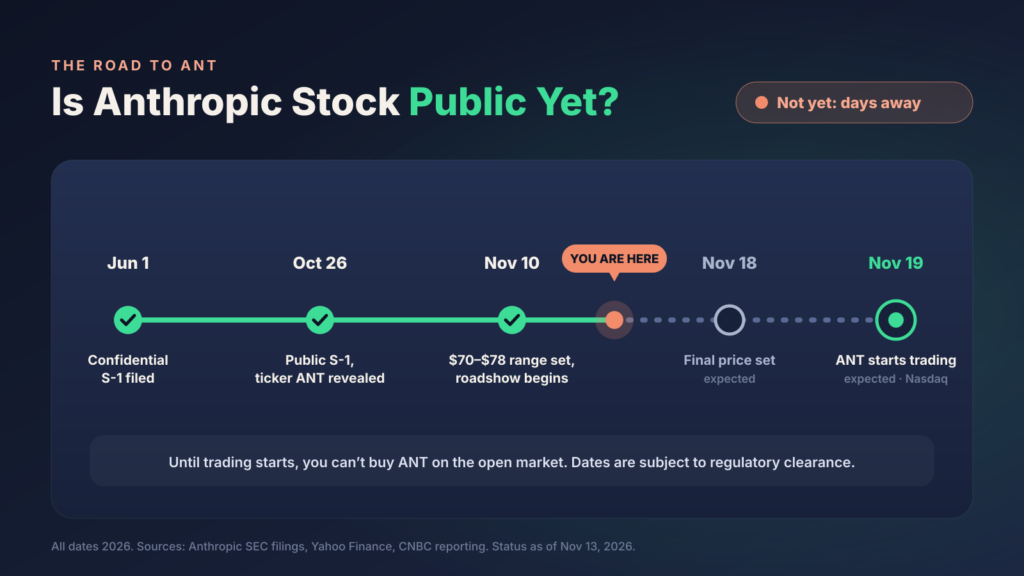
Not yet, but it’s close enough that investors are already elbowing each other for shares. As of mid-November 2026, you can’t buy Anthropic stock in a regular brokerage account, because the company hasn’t completed its initial public offering. What has changed is that the IPO is now concrete, scheduled, and priced within a range. because the company has no longer completed its preliminary public offering.
Things moved quickly. Anthropic confidentially submitted a draft S-1 to the SEC on June 1, 2026. It made the filing public on October 26, revealing the ticker ANT. Then, on November 10, an amended filing set a price range of $70 to $78 per share for 825 million Class A shares, a step that usually marks the start of the investor roadshow.
The key IPO numbers at a glance
| Detail | What the filings and reports say |
| Company | Anthropic, PBC (a Delaware public benefit corporation) |
| Ticker and exchange | ANT, Nasdaq Global Select Market |
| Shares offered | 825 million Class A shares (801.4 million new, 23.6 million from existing holders) |
| Price range | $70 to $78 per share |
| Money raised at top of range | About $64.35 billion |
| Implied valuation | Roughly $1.26 trillion to $1.41 trillion, fully diluted |
| Expected pricing | November 18, 2026, subject to regulatory clearance |
| Expected first trade | November 19, 2026 |
| Lead underwriters | Goldman Sachs, Morgan Stanley, J.P. Morgan and Citi |
| Retail allocation | Reportedly 15% to 20% of the offering |
That retail slice is unusually generous. Most IPOs deal with ordinary buyers just like the children’s desk at a marriage: technically invited, served closing. A target near one-fifth of the deal is a massive deal in itself.
How Anthropic’s business looks on paper

The growth story is the headline. According to the S-1, revenue went from about $386 million in 2024 to $4.6 billion in 2025, then $16.3 billion in just the first half of 2026. For context, the May 2026 Series H round raised $65 billion at a $965 billion post-money valuation. That means public buyers at the IPO are paying a premium over the last private valuation.
Most of that revenue is usage-based. About 80% of first-half 2026 revenue came from usage-based fees, with subscriptions making up the remaining 20%. Businesses pay for how much they use Claude through the API, Claude Code, and enterprise plans. That makes growth fast in good times, but it also means revenue can drop quickly if customers cut back.
Ways to Invest in Anthropic Stock
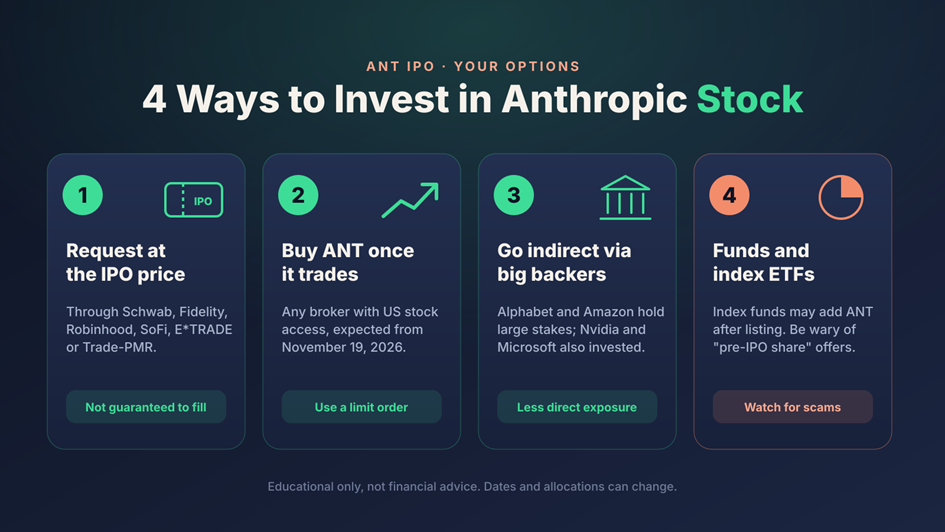
There’s no single “right” way in. When sizing up any IPO, it helps to ask three questions: How much do I want shares at the IPO price? How much risk can I handle? And would I rather own the company directly, or get exposure through a bigger one?
1. Request shares at the IPO price through your broker
This is the route most people are excited about. Anthropic’s amended S-1 names six platforms that will offer part of the deal to retail investors at the IPO price: Charles Schwab, Fidelity, Robinhood, SoFi, E*TRADE from Morgan Stanley, and Trade-PMR (which mainly serves financial advisors).
Here is the honest assessment. Requesting stocks is like placing your name on a eating place waitlist: But putting in a request is like joining a restaurant waitlist: it isn’t the same as getting a table. Each broker gets a limited pool of shares, sets its own eligibility rules, and may fill your order partly or not at all. Some platforms also limit future allocations for people who flip IPO shares quickly. SoFi and Robinhood have said that customers who sold shares from earlier IPOs within 30 days may be restricted. Treat an allocation like finding cash in an old jacket pocket: nice if it happens, terrible as a financial plan.
2. Buy ANT on the Nasdaq after it starts trading
For most investors, this is the sensible route. Once ANT starts trading, expected on November 19, any broker with access to US stocks will let you buy it at the market price, just like Apple or Nvidia. You don’t need an allocation, a minimum account balance, or special approval.
The trade-off is price. Hot IPOs often open well above the offer price, so day-one buyers may pay a hefty premium over what allocation holders paid. A common rule of thumb is to let the first-day frenzy cool before buying, and plenty of experienced investors do exactly that.
3. Get indirect exposure through Alphabet, Amazon and other backers
If buying a brand-new stock feels like jumping onto a moving train, you can instead own companies that already hold a piece of Anthropic. Amazon has committed up to $33 billion to Anthropic, and Alphabet holds a stake of roughly 14%. According to Reuters’ calculations, at the top of the IPO price range, Amazon’s position could be worth about $272 billion and Alphabet’s about $139 billion. Nvidia and Microsoft also invested in 2025.
The upside is diversification: these giants have many other businesses. The downside is the same thing. Anthropic is only a small slice of a company like Alphabet, so even a big ANT rally moves those shares only modestly. It’s like buying a whole pizza because you love one topping.
4. Funds and index ETFs (and why pre-IPO offers need extra caution)
Some funds claim to already hold private Anthropic shares, and index funds may follow after the listing. The Nasdaq-100 now has a fast-entry rule for very large IPOs, so ANT could appear in Nasdaq-100 funds (such as QQQ) about three weeks after it starts trading. The S&P 500 is different: it requires at least 12 months of trading history, so S&P 500 funds won’t hold ANT for at least a year.
Be careful with anything sold as “pre-IPO Anthropic stock.” Anthropic has said that any share transfer without its board’s approval is void, and that it doesn’t allow special-purpose vehicles (SPVs) to buy its stock. NerdWallet also notes that some funds’ claimed Anthropic stakes could not be verified. With the listing just days away, chasing pre-IPO deals now adds risk for very little benefit. If a stranger in your DMs is offering “exclusive pre-IPO Anthropic shares,” the only exclusive thing on offer is the scam.
Step-by-Step, How to Buy Anthropic Shares
Ready to act? Here’s a simple checklist to follow, whether you’re aiming for an IPO allocation or a simple open-market buy.
- Pick a brokerage that suits your goal. If you want a shot at shares at the IPO price, use one of the six platforms named in the S-1. If you only plan to buy after the listing, any legitimate broker with access to US stocks will work.
- Open and fund your account early. Identity checks and bank transfers can take several days. Funding at the last minute is a classic way to miss an IPO window and spend the night angrily refreshing your banking app.
- Read the prospectus summary. You don’t need to read all of it, but skim the business overview, the financial tables and the risk factors. You can find it in the SEC’s EDGAR database.
- Find your broker’s IPO section and submit a request. On apps like Robinhood or SoFi, this usually means opening the IPO listing, entering how many shares or dollars you want, and confirming a maximum price. Request windows usually close shortly before pricing, which is expected on November 18.
- Check your allocation. After pricing, your broker will tell you whether you got shares, how many, and at what final price. Partial fills are common in popular deals.
- No allocation? Plan your open-market buy. If you buy on November 19, use a limit order instead of a market order. A limit order caps the price you pay, which protects you from a wild opening price and a very awkward conversation with your future self. If you take only one tip from this guide, make it this one.
- Size your position sensibly. A single new stock, especially a volatile IPO, should usually be a small part of a diversified portfolio. Decide your maximum amount before the excitement starts.
- Think about your holding plan. Selling allocated shares quickly can hurt your chances in future IPOs at some brokers. In the US, short-term gains are also usually taxed more heavily than long-term ones.
Risks to Understand Before You Buy
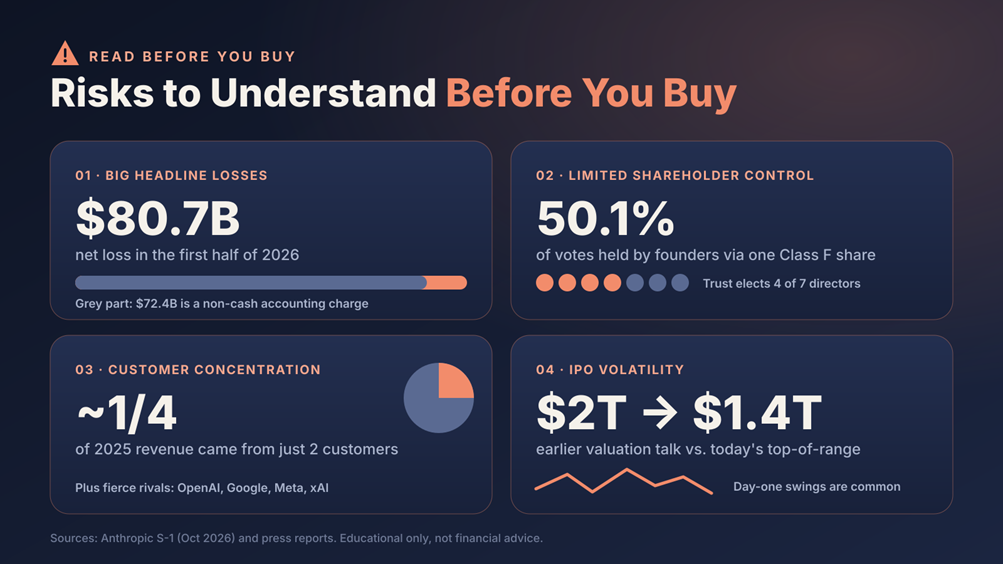
Anthropic itself seems to want investors to read the fine print. Reuters, which reviewed the draft prospectus, reported that roughly 80 of its 261 main pages cover risk factors, compared with 48 pages describing the business. Of all those risks, these four stand out the most.
Big headline losses (and what is behind them)
The S-1 shows a net loss of $80.7 billion for the first half of 2026. That number looks like a typo at first glance, but here’s what most headlines skip: $72.4 billion of it is a non-cash change in the fair value of convertible notes, derivatives and SAFEs. In plain English, as Anthropic’s private valuation rose, those financing instruments became more valuable to their holders, and accounting rules record that as a loss. Yes, the company becoming more valuable shows up as losing money. Accounting is weird like that.
The underlying business is still expensive to run. Training and serving frontier AI models takes enormous amounts of computing power, and the company has hundreds of billions of dollars in long-term cloud and infrastructure commitments. Profitability isn’t guaranteed.
You get the shares, not the steering wheel.
Honestly, this is the risk retail investors overlook the most. Anthropic’s seven co-founders control a single Class F share that carries 50.1% of total voting power, and a Long-Term Benefit Trust elects 4 of the 7 board directors. Public Class A holders can’t elect a director on their own. The company openly warns that this structure may lead to decisions that conflict with shareholders’ financial interests. As a public benefit corporation, it can also weigh its safety mission alongside profit.
Customer concentration and fierce competition
Nearly a quarter of 2025 revenue came from just two customers, and many of its largest customers aren’t locked into long-term contracts. Meanwhile, Anthropic competes head-on with OpenAI, Google, Meta and xAI for customers, talent and chips. Government action is another wildcard: the risk factors cite federal restrictions that have already affected parts of the business.
First-day IPO volatility
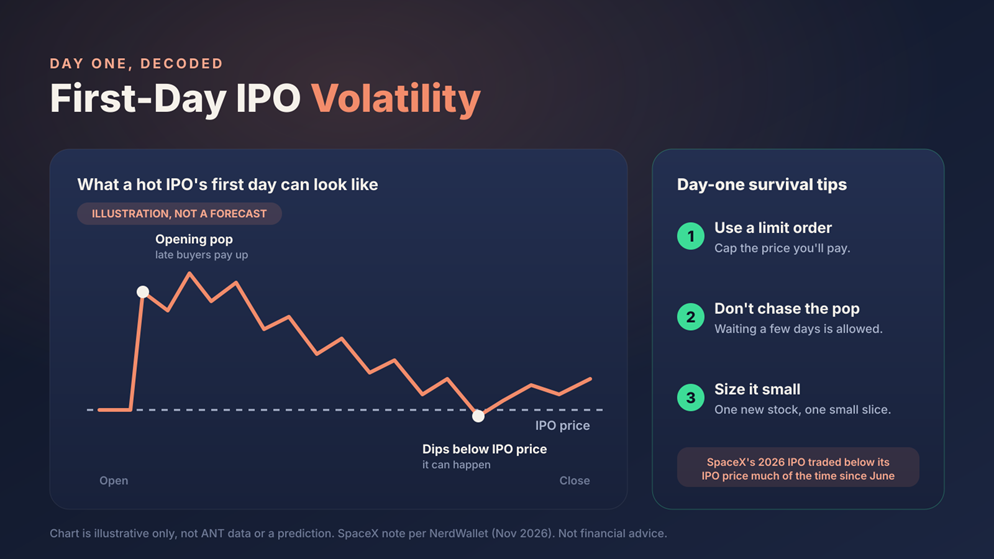
Mega-IPOs can swing harder than a toddler’s mood after a sugar rush. The market mood has also cooled: earlier talk of a $2 trillion valuation shrank to about $1.4 trillion (fully diluted, at the top of the price range) as Wall Street grew nervous about AI spending. SpaceX, another giant 2026 IPO, shows how fast hype can fade. Its stock soared to $225.64 within days of its June debut, then slid below its $135 IPO price, where it has spent long stretches since. Hype is fun, but it doesn’t pay your bills.
Conclusion
The good news: Anthropic stock is no longer a members-only party. If you want the best possible price, request an allocation through Schwab, Fidelity, Robinhood, SoFi or E*TRADE before your broker’s request window closes ahead of pricing on November 18, and keep your expectations modest. If you miss out, you can buy ANT on the Nasdaq from November 19 using a limit order, or take the slower route through Alphabet, Amazon, and Nasdaq-100 index funds.
Whichever route you choose, remember what you’re buying. Anthropic is growing at a pace few companies have ever matched, but it comes with heavy computing costs, huge accounting losses, and a governance setup that remains controlled by its founders and trust. If you’re buying, read the risk factors, set a budget in advance, and never let IPO hype make the call. Start small, think long term, and let the business prove itself quarter by quarter. In investing, as in online shopping at 2 a.m., excitement gets expensive.
FAQs
Can I buy Anthropic stock before the IPO?
Realistically, no. Before the IPO, Anthropic shares only changed hands privately, and the company requires board approval for any transfer. According to NerdWallet, popular secondary marketplaces such as Forge and Hiive don’t currently offer its stock. The closest you can get is requesting an allocation at the IPO price through a participating broker. Treat any website or social media post promoting “pre-IPO Anthropic shares” as a likely scam.
What is Anthropic’s stock ticker and when does it start trading?
The ticker is ANT, and the stock will be listed on the Nasdaq Global Select Market. Anthropic expects to set its final price on November 18, 2026, and begin trading on November 19, 2026, subject to regulatory approval. Market conditions can delay IPOs, so confirm the date with your broker as it gets closer.
Can non-US investors buy Anthropic stock?
Usually yes, once it lists. Any international broker that offers US-listed stocks should be able to give you access to ANT once it starts trading. Getting shares at the IPO price is different: the six named retail platforms are US brokers, although the filing mentions a separate retail offering in certain European countries. Before you invest, check your local regulations, currency conversion fees, and US tax rules for foreign investors.