Introduction: AI Startup Funding
Nobody wakes up hoping to read an IPO prospectus. You learn what an S-1 is the way most people learn things: suddenly, and because everyone on your timeline is screaming about it. One minute you’re scrolling past a chatbot ad; the next you’re googling “is $1.3 trillion a normal number or a we-are-in-a-bubble number.” Welcome to November 2026, the month AI money stopped pretending to be private. Anthropic just pulled off the largest IPO in history.
At TachCrunch.com, we cover the latest technology, AI, and business developments, helping readers understand the funding deals, market shifts, and major announcements shaping the tech industry.
OpenAI quietly trimmed its own ambitions and pushed its listing to next year. Nvidia posted a quarter so big it reads like a typo, in the same week its legendary CEO walked out the door. And underneath all of that, thousands of smaller startups are fighting over whatever capital the giants leave behind. Here’s the full breakdown of funding, IPOs, valuations and earnings, minus the hype, minus the jargon, plus a little honesty.
Anthropic’s IPO: The Biggest Listing Ever, by a Lot
Let’s start with the headline nobody could scroll past.
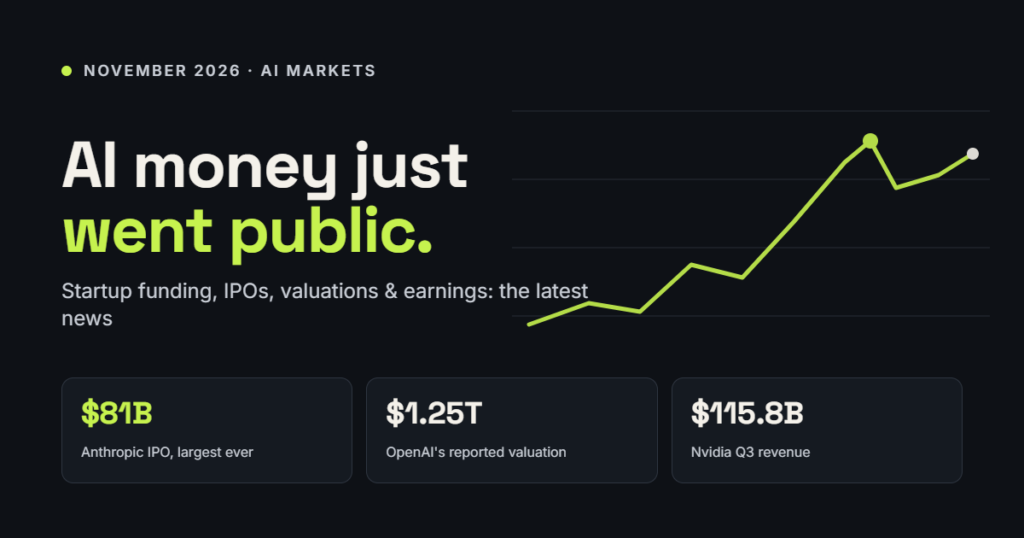
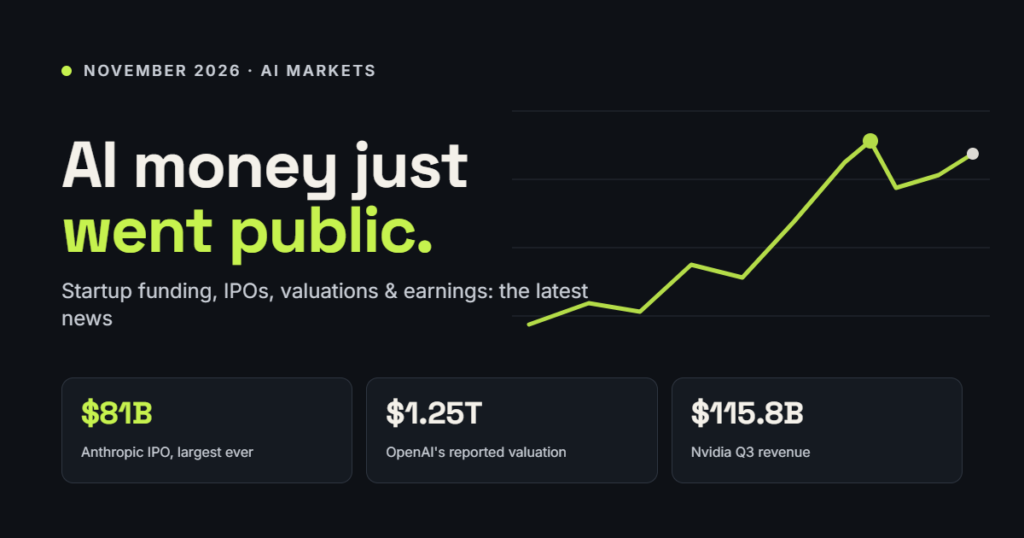
Pricing, raise size, and demand. Anthropic priced its IPO at $83 a share on November 18, above its marketed $70 to $78 range, and sold 980 million Class A shares for roughly $81 billion. That officially beat SpaceX’s $75 billion June listing as the largest IPO ever. At pricing, Renaissance Capital put the company’s fully diluted value at about $1.38 trillion.
Demand wasn’t subtle. Bloomberg reported that orders reached roughly six times the shares on offer during the roadshow. Goldman Sachs and Morgan Stanley led the deal, and the stock listed on the Nasdaq under the ticker ANT.
Day one: the pop, then the reality check. Shares opened at $111.50 on November 19, about 34% above the IPO price, touched $115.10, and then did what hyped stocks do when the wider market is having a bad day: they slid. ANT closed at $97.17, up about 17% from $83. That works out to roughly $1.28 trillion on basic shares and around $1.8 trillion fully diluted, per CNBC.
So was that a win? Honestly, yes, just not a fairy-tale one. A 17% first-day gain on an $81 billion raise, on a day when the major US indexes fell, is strong. But anyone who bought at the open was underwater by the close. That’s the IPO lesson in one candle: the price you see on the news and the price you actually pay are two very different animals.
And remember how fast this happened. Anthropic only filed confidentially on June 1, right after a $65 billion Series H at a $965 billion valuation that briefly made it the world’s most valuable startup. From private darling to trillion-dollar public company in under six months. Blink, and you missed it.
OpenAI: $1.25 Trillion, but Smaller Than It Wanted

OpenAI’s numbers are still absurd, just a little less absurd than planned.
On November 6, Bloomberg and Reuters reported that OpenAI closed at about $11 billion as the first piece of a round valuing it at $1.25 trillion. Back in September, it was reportedly hunting for $30 billion at around $1.4 trillion. Now the total target is closer to $20 billion, and some investors say the price came down.
Context matters, though. In March, OpenAI closed a record $122 billion round at an $852 billion post-money valuation, anchored by Amazon, Nvidia and SoftBank. So $1.25 trillion is still roughly a 47% climb in about eight months. That’s not a crisis. That’s a company that asked for the moon and settled for a very large asteroid.
The bigger plot twist? According to the Associated Press, OpenAI decided to postpone its IPO until next year, which hands Anthropic the “first frontier AI lab on Wall Street” crown. In this race, timing is half the valuation.
Startup Funding: Record Money, Fewer Hands
Zoom out from the trillion-dollar duo and the picture gets more interesting, and a lot more uneven.
ZPlatform, which only counts rounds backed by company announcements, filings, or reputable reports, tallied $24.6 billion across 119 AI rounds between September 1 and November 16, 2026, with a median round of $56 million. Translation: big checks exist, but most companies are not getting billions. They’re getting tens of millions and a long list of questions.
The standouts this month:
- Thinking Machines Lab, Mira Murati’s startup, is reportedly raising $5 billion at a $40 billion pre-money valuation, led by Accel, according to Business Insider. Note the downgrade: earlier talks at around $50 billion reportedly fell apart, and the same report said about a third of the founding team has left.
- fal, the generative-media inference company, announced $1.3 billion at roughly a $16 billion valuation on November 3.
- BrightAI raised $97 million for physical AI in essential services on November 18, one of only two deals that day above $11 million.
The pattern is loud. Investors will pay up for compute, infrastructure, and proven revenue. Everyone else gets interrogated. A smaller-than-hoped round for a famous founder isn’t a scandal anymore; it’s just Tuesday.
Earnings: Nvidia Still Holds Up the Whole Building

If AI valuations are a skyscraper, Nvidia’s earnings are the foundation everybody nervously inspects every quarter.
On November 17, Nvidia reported fiscal third-quarter revenue of $115.8 billion, up 103% year over year and 20% from the prior quarter, with GAAP net income of $65.3 billion. It guided for about $130 billion next quarter while assuming zero data-center compute sales to China. It also said it shipped $2.4 billion of older Hopper chips to China during the quarter and has since stopped.
The strange part: this was its first report since Jensen Huang resigned as CEO on November 12. CFO Colette Kress is running the company while the board searches for a successor. The stock walked into earnings down about 17% for the year, and the numbers still delivered.
Why should startup watchers care? Because Nvidia’s revenue is basically a receipt for everyone else’s spending. Its customer cloud backlog reportedly sits around $2.5 trillion. As long as that pipeline holds, labs keep raising, and investors keep believing the revenue will eventually show up downstream.
The IPO Hangover: Cerebras and SpaceX Are the Warning Labels
Before you get starry-eyed about ANT, look at the rest of the class of 2026.
Cerebras priced at $185 in May after demand ran more than 20 times the shares available. It opened at $350 and closed day one at $311.07. Then gravity showed up: the Motley Fool reported the stock has since fallen about 52% from that first-day close.
SpaceX, the June record-holder, jumped above $200 after listing, slid to about $108, and was recently trading near its $135 IPO price, according to NPR.
Neither company is “failing.” Cerebras reportedly has a backlog of around $25 billion. But both prove a first-day pop is a mood, not a business model.
Valuation vs. Earnings: The Question Nobody Can Skip
Here’s the uncomfortable math. Anthropic grew revenue fast in early 2026 but was still losing money, per ABC News. Morningstar argues its premium valuation hinges on reaching 40% gross margins this year; miss that, and the whole valuation debate reopens. Morningstar also cites PitchBook research suggesting the highest-valued AI companies often sit on the weakest fundamentals.
So two stories are running at once. One says AI demand is real, and Nvidia’s receipts prove it. The other says prices have sprinted way ahead of profits. Both can be true at the same time, and that’s exactly what makes this market so chaotic, and so watchable.
FAQs
1. What was the biggest AI IPO of 2026?
Anthropic. It priced at $83 a share and raised about $81 billion, beating SpaceX’s $75 billion June IPO as the largest listing ever. Shares closed their first day at $97.17.
2. Is OpenAI going public?
Not this year. The Associated Press reported that OpenAI postponed its IPO until next year. Its latest reported funding round values it at $1.25 trillion, with about $11 billion closed so far.
3. Is AI startup funding a bubble?
Nobody can say for sure, and anyone who sounds 100% certain is guessing. The bull case: Nvidia’s record earnings and huge order backlogs show real demand. The bear case: big valuations are being cut, profits lag, and recent AI IPOs like Cerebras have fallen sharply after their debuts.
Conclusion
So, is this a $200 problem or a sell-the-house problem? Honestly, neither, yet. November 2026 proved AI money is very real: Anthropic pulled off the biggest IPO in history, OpenAI still commands a trillion-plus price tag, and Nvidia keeps printing receipts that justify the spending. But the month also showed the cracks. Rounds are shrinking from what founders asked for.
Famous labs are accepting lower valuations. And the post-IPO charts from Cerebras and SpaceX are a reminder that hype has a half-life.
If you’re an investor, watch margins, not headlines. If you’re a founder, bring revenue, not vibes. And if you’re just here for the drama, grab a coffee. OpenAI’s next move, Nvidia’s CEO search, and ANT’s first earnings report are all still loading. Something tells me the kitchen floor isn’t dry yet.