
Introduction: Anthropic Valuation
What’s behind AI company Anthropic’s stunning $4.6B funding? A company that makes tools to help computers better understand language is among the most hyped and fastest-growing in AI. Now, its soon-to-be public stock is getting a great deal of attention for a different reason: Investors are talking about its eye-popping valuation.
But that number is not the final valuation, which was reported last week at about $1.5 trillion. Investors have wondered whether the company can reach such a lofty valuation amid a technology sell-off, AI infrastructure investments, and doubts about how much money artificial intelligence will make.
U.S. market blog Reuters (11/10) questioned what had happened by reporting that on that date, Anthropic provided financial information to the bankers for its IPO and later withdrew it. Reuters said the company would update the filing, but did not pinpoint a revised share price or valuation.
For those of you invested in the AI industry, the bigger question is not just the trillion-dollar mark but how investors value an AI company and what could increase or decrease that value.
Latest Update: Anthropic’s IPO Pricing Details Remain Uncertain
Anthropic’s plans to IPO have drawn interest due to the size of the offering. An initial report estimated the valuation at the time of the offering at close to $1.5 trillion and an amount that could raise up to $100 billion.
There are reports that some potential investors thought Anthropic would have to cut its valuation, and that the company could opt for a smaller capital raise or an even longer delay if market conditions do not improve.
The target prices on bankers’ wires should not be considered final. Bloomberg reported that the company withdrew the information later and disclosed that a revised filing was forthcoming. The firm has not announced the final pricing, number of shares, or value of the IPO.
That’s important, because documents we review before an IPO launch may include estimates, descriptions, and transcripts that may, in fact, be altered at any time before an offering goes live.
What Is Anthropic’s Valuation?
A valuation is a rough idea of the entire worth of a company. For private companies like Anthropic, a valuation can be the result of funding rounds, negotiations with investors, or other financial transactions.
The valuation of the company as reported by Anthropic has skyrocketed as it has raised cash and grown its artificial intelligence (AI) business. The private funding valuation, however, is not the valuation the company will get when it goes to the public market.
An estimated IPO valuation is derived from the price at which a company intends to sell shares to public investors. After the opening of trading, the company’s value can change, driven by investors’ response to its performance and market conditions.
The readers will recognize three figures:
- Private funding valuation: The agreed private investment round value.
- An approximation mentioned by the company, its advisors, or potential investors.
- Public-market valuation: The value implied by the share price once the company starts trading.
- These numbers are interrelated, but they’re not interchangeable. Just because a funding round was private doesn’t mean public investors will pay the same rate. On the other hand, an IPO forecast is not the same thing as a final market outcome.
Why Is Anthropic’s IPO Valuation Changing?
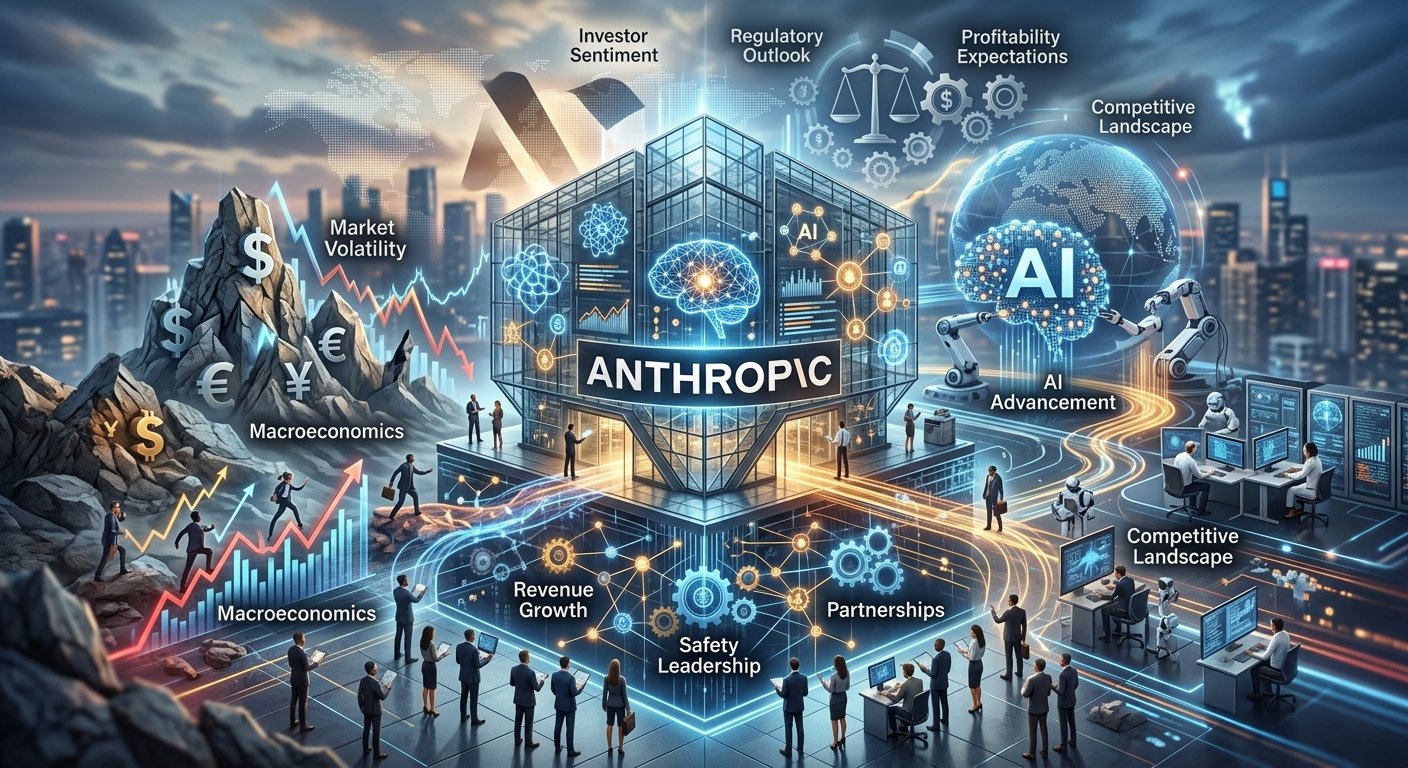
The valuation expectations for Anthropic have fluctuated as the tech market has evolved. Some investors have spoken of a $1.5 trillion valuation, and others have estimated that the company might have to settle for a lower number. An investor estimate mentioned in recent reporting suggested the company would have to settle for near the $1 trillion mark.
That variation doesn’t inherently suggest the firm or its technology is in decline. Companies can see their valuations in public markets shift due to things beyond their influence.
For example, investors might be less eager to bid for technology stocks as borrowing costs increase, markets decline, or worries about AI spending grow. Firms can sustain growth even as investors recalculate how much they are willing to pay for that future.
Like any IPO, whilst it has the advantage of raising a large amount of cash, it also has the disadvantage of having to find a given valuation.
Those who price their offer too high will repel potential investors and see the offer fail; those who set a price too low could raise less money than they otherwise might have done, or invite criticism of undervaluing their shares.
What the end valuation will be is a matter of investor interest, financial disclosures, overall market conditions, and the decisions of the company.
Private Valuation of Anthropic compared to Its Potential IPO Valuation

One of the reasons valuation headlines can be difficult to interpret is that private and public investors may value the same company differently.
The private funding valuation is based on the terms of a particular investment deal. The IPO valuation is based on the price at which the company anticipates offering shares to public investors. From then on, the market price can fluctuate after trading begins.
Private-sector investors might be willing to pay a premium if they believe a company will grow substantially for many years. Investors in the public market may view the company differently if they are concerned about one or more factors,s including near-term costs, competitors, or market volatility.
This is particularly the case for AI firms. While they have a potentially enormous long-term opportunity, AI firms can also have huge infrastructure and research costs.
Thus, a high private valuation does not ensure a high IPO valuation either. The issue in the public offering is a larger set of investors that may have a different set of profitability, growth, and risk trade-offs.
What Could Support a High Anthropic Valuation?
Anthropic is priced in relation to the commercial market for AI. Its Claude models are used for coding, writing, research, analysis, and overall business productivity. The startup is going head-to-head with larger players for customers seeking AI systems that allow their workers to do more work.
Companies might pay for AI that cuts costs, enhances quality, or enables new products. If Anthropic can develop those markets into a steady flow of revenue, that should bode well for the company as a long-term investment.
Several factors could support investor interest.
Enterprise AI Demand
Businesses are investigating AI software to help build products, support customers, conduct research,h and automate operations. Large customers could also like dependable systems that fit into their current workflows.
Commercial Position of Claude
Anthropic’s Claude offerings and coding tools enable it to compete in a market where companies compare AI providers on how well they perform, their reliability and security, and the price.
Opportunity for Recurring Revenue
Subscriptions and enterprise deals could generate recurring revenue. Investors will want to see customers stick with Anthropic’s products over time and whether the company can deepen its relationships with businesses.
The Broader AI Opportunity
AI is starting to be used in many different industries. If a company has a successful product line and a customer base that wants those products, then that company has an opportunity to grow.
Having a big market doesn’t mean any one company gets a sizable chunk of value out of it. Competition, price pressure, and the cost of developing the infrastructure can diminish the return.
Revenue Growth: A Key Part of the Valuation Debate
Revenue is a key measure that investors use to evaluate a company. It represents the amount of money that a company earns from sales before operating expenses are subtracted.
Recent articles have indicated significant revenue growth at Anthropic. The Financial Times reported that the company’s quarterly revenue increased by around 50% to $17 billion in the third quarter, and its annualized revenue run rate was reportedly close to $81 billion. These are estimated based on the forecasted figures and may not be representative of future revenue.
An annualized revenue run rate is not audited annual revenue. It typically takes one figure at a given point in time and extrapolates it over a greater period. It may reflect the current speed of a company, but it doesn’t mean you will get the same revenue.
Investors will question whether the revenue growth at Anthropic can be maintained, what proportion is generated by repeat customers, and whether the company can grow without its costs growing at an even greater pace.
Revenue growth alone can’t make a company profitable.
The Costs Behind Anthropic’s AI Growth
One of the most significant issues that investors will need to weigh is the cost of developing and running AI models.
AI models have costs; they need compute, specially built chips, data centers, energy, engineers, and continued research. They can go up as a company takes on more users or more powerful models.
Recent coverage has focused on Anthropic’s large infrastructure and computing commitments. One of the few reasons investors are interested in looking at the company’s capital needs and revenue growth together is the scale of these commitments.
This raises a significant valuation issue:
- Will Anthropic generate sufficient revenue and ultimately turn a profit to cover its costs?
- A business can expand at a rapid rate while being cost under stress if expenses increase at a rate equal to or more than the rate of revenue.
- Investors will need to know how cost-effective the use of computing resources is for Anthropic, the cost per customer, and whether the business model will be able to generate sustainable returns.
What Does a Trillion-Dollar Valuation Actually Mean?
A trillion-dollar valuation might seem like a simple way to measure the success of a company, but that number is actually an estimate of the total value of the entire business – not the cash sitting in its bank account.
It is important to remember that a trillion-dollar company does not mean a trillion dollars’ worth of assets, or that the current valuation justifies that amount of profit for the present financial year. The valuation indicates a potential value of the company in the investors’ eyes.
That matters especially to AI firms: Investors are likely to be pricing in growth, new offerings, and the probability that AI will become a key part of the global economy.
But they may change. Investors could readjust their estimates of the future if there are signs that revenue growth is slowing, costs are going up, or market competition is heating up.
And so high a valuation can be a blessing and a curse. It can be a vote of confidence in what you’re doing – but it also leaves you less elbow room if you’re not doing it as well as hoped.
Three Possible Outcomes for Anthropic’s IPO
The ultimate IPO terms for Anthropic will be based on market conditions and the company’s choices. There are many different scenarios possible, and no one should interpret this as a forecast.
1. Anthropic Prices the IPO Near Its Higher Expectations
Since pent-up investor interest seems brisk, Anthropic may attempt to command a valuation near the highest numbers mentioned earlier.
An IPO at that level could boost investor confidence for the AI sector. But investors would still have to judge if the company’s financials can justify the price.
2. Anthropic Chooses a Lower Valuation
In this case, however, a lower IPO valuation would have the potential to support shares if investors see more upside in the company’s growth potential but at the same time want a wider margin of safety.
It would not be an indication of a failure if the price was lower. This could be a marketing move to generate demand, to avoid a weak opening, or might be indicative of a different market climate.
3. Anthropic Delays or Revises Its Offering
It can also change its IPO schedule if the market is feeling unstable. If prospective investors are uneasy with the asking price, Anthropic could alter the timeline or terms.
-Recent news coverage has raised questions about the offering, including fears of price volatility in the market and the sell-down valuation investors are willing to accept.
A delay wouldn’t preclude the company’s prospects for the future. It might merely indicate the challenge of bringing a sizable public offering to market in a turbulent market.
What Investors and Readers Should Watch Next

For those tracking what is sure to be an IPO, followed by those in the know, the confirmed facts will be far more useful than any guesses on the valuation.
Watch for:
- Updated IPO filing: The company changed its statement, which could shed light on the offering.
- This will indicate the desired valuation for Anthropic and its advisors.
- The number of shares being offered will influence the company’s implied market value.
- Financial disclosures: Revenue, costs, cash, and financial obligations assist investors in evaluating the company.
- The prevailing buy interest may affect the ultimate price of the IPO.
- The listed public share price can go up or down after the listing.
- This will assist in differentiating reported expectations from actual details.
What Anthropic’s Valuation Could Mean for the AI Industry
Anthropic’s IPO could serve as a good barometer for the overall AI market. If the offering goes well, it could boost investor confidence in the AI industry and demonstrate that retail investors are open to backing tech firms with bold visions for their future.
The weaker reception might have the opposite result. Investors may be less forgiving of companies that need to spend a lot before they can produce sustainable profits.
The effects could ripple beyond Anthropic. Chip makers, AI builders, cloud providers, and data center operators are all linked to the expansion of the AI ecosystem.
But one IPO can’t decide the future value of every AI business. Every AI business is different – they sell a different set of products to a different set of customers at a different cost, and they face different financial risks.
The upshot is to look past a headline valuation. If you are considering investing in a firm, its business performance, customer loyalty, infrastructure spending, and financial future are just as important as its numerical denomination.
Conclusion
Implications. AI is full of promise and pitfalls. Anthropic gained billions of dollars in investment and emerged as a major player in the AI space, and its valuation when it goes public will depend on demand and market circumstances.
While $1.5 trillion has been cited, other investors have been working with lower figures. The news reports about the withdrawn pricing details of the IPO offer are an example of why investors need to be able to differentiate between initial information and final offerings.
In the end, however, getting onto the market will involve more than just euphoria about AI. Investors will want to consider revenue, expenses, the level of competition, capital needs, and whether they think the technology can be converted into a lasting business.
For those following the tech and business news, TachCrunch.com will keep reporting on issues such as Anthropic’s IPO, valuation of AI companies, and whether the dollars being raised in the market are an indication of the future of AI.
FAQs
What is Anthropic’s valuation?
It is said that a potential IPO valuation for Anthropic’s IPO may be $ 1 trillion, but that is not confirmed. The valuation will depend on the terms for the IPO and investor appetite.
Is Anthropic’s $1.5 trillion IPO valuation confirmed?
No. The $1.5tn number has been used in coverage of the investor conversations. It is not the reported IPO valuation or final share price.
Why are investors questioning Anthropic’s valuation?
Investors want to know about the market environment and AI investments, competitors, overall financials, and whether the company has a compelling case for the valuation because of future growth.
What is the difference between private valuation and IPO valuation?
A private valuation is based on either a private fundraising deal or an investor valuation. An IPO valuation is based on the number of shares and share price for a public listing. Market value is subject to change after trading starts.
What should readers watch before Anthropic goes public?
Look for the revised IPO filing, validated share price range, number of shares being offered, financial statements, and any information on investor demand. These are more dependable than the valuation estimates floated earlier.