Introduction: How Many Periods Are in Hockey Games?
If you have ever sat down to watch your first hockey game, you probably noticed something odd. There are no halves like soccer and no four quarters like basketball. Instead, hockey is split into three periods.
That simple answer hides a lot of interesting detail. How long is each period? Why does a “60-minute” game take two and a half hours to watch? What happens when the score is tied after the third period? And do college, Olympic, and youth games follow the same rules as the NHL?
This guide answers all of that. You will learn how periods work in the NHL, how overtime changes between the regular season and the playoffs, how NCAA and Olympic hockey differ, and even why field hockey uses quarters instead. By the end, you will understand the hockey clock better than most casual fans.
The Short Answer: 3 Periods of 20 Minutes
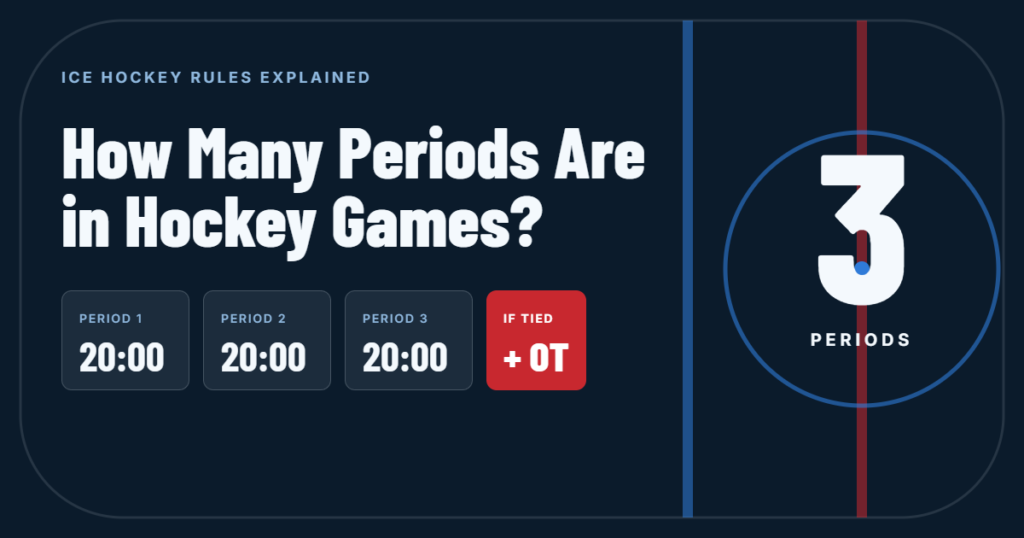
At nearly every adult level of ice hockey, a game has three 20-minute periods. That gives 60 minutes of regulation time. The NHL, NCAA college hockey, and the Olympics all use this same structure.
The team with more goals after 60 minutes wins. If the score is level, the game moves into overtime, and the rules for that depend on the league and the stage of the season.
Why hockey uses periods instead of halves or quarters
The main reason is the ice. Skates carve up the surface quickly, and a rough sheet slows the puck and makes play unpredictable. Breaking the game into three parts gives arena crews two chances to resurface the ice during a game.
It also helps the players. Hockey is one of the most demanding sports in the world, with shifts often lasting under a minute at full speed. Two longer rests let players recover, and coaches use them to adjust tactics.
How Periods Work in the NHL

The NHL sets the standard that most other leagues copy. Under the NHL Official Rules (link to the rulebook on NHL.com, see the backlink plan), a game is three periods of 20 minutes of actual play.
Period length and the stop-time clock
The key phrase is “actual play.” Hockey uses a stop-time clock. The clock stops for every whistle: offsides, icing, penalties, goals, pucks out of play, and injuries. A 20-minute period therefore takes far longer than 20 minutes on your watch, usually 30 to 40 minutes.
Teams also switch ends after each period. In the second period, each team’s bench is farther from the net it attacks, which creates the famous “long change” and often leads to more goals in the middle frame.
How long are hockey intermissions?
NHL intermissions run about 18 minutes, according to the league’s rulebook, though you will often see them described as 17 minutes. They come after the first and second periods. During this time, Zambonis resurface the ice, players rest in the locker room, and broadcasters fill the gap with analysis.
What Happens if the Game Is Tied? Overtime Explained
A tied hockey game after three periods does not simply end in a draw in the NHL. Overtime decides it, but the format changes completely between the regular season and the playoffs.
NHL regular season: 3-on-3 overtime and the shootout
In the regular season, a tied game goes to a five-minute, sudden-death overtime played 3-on-3. The first team to score wins immediately. With only three skaters per side, the ice opens up and scoring chances come fast.
If nobody scores in those five minutes, the game goes to a shootout. Each team sends three shooters at the opposing goalie. If it is still tied, the shootout continues one shooter at a time until one team scores and the other misses. The winner gets two points in the standings, and the losing team still collects one point for reaching overtime.
Stanley Cup Playoffs: unlimited 20-minute sudden-death periods
The playoffs drop the shootout entirely. In playoff overtime, teams play full 20-minute periods at 5-on-5, with an intermission and ice resurfacing between each one. The first goal ends the game.
Because there is no limit, playoff games can run very long. The longest game in NHL history, Detroit against the Montreal Maroons in March 1936, needed six overtime periods before Mud Bruneteau scored the only goal. That game featured nine periods in total.
Periods in College Hockey (NCAA)

College hockey in the United States also uses three 20-minute periods. Overtime is where it differs from the NHL.
Since the 2020-21 season, NCAA regular-season games tied after regulation use a five-minute, 3-on-3 sudden-victory overtime, a change approved by the NCAA Playing Rules Oversight Panel. In non-conference games, the result can stay a tie if nobody scores. Conferences may add a shootout to award an extra standings point, and College Hockey Inc. notes that teams switch ends for overtime.
In the NCAA tournament, ties cannot stand, so games continue with full 20-minute 5-on-5 sudden-death periods, much like the Stanley Cup Playoffs.
Periods in Olympic and International (IIHF) Hockey
Olympic and other international games follow International Ice Hockey Federation (IIHF) rules. They still use three 20-minute periods, but intermissions are shorter at 15 minutes.
Overtime changes by tournament stage, as seen at the 2026 Milan Cortina Games:
- Preliminary round: five minutes of 3-on-3 sudden death, then a shootout of at least five rounds.
- Quarterfinals and semifinals: ten minutes of 3-on-3, then a shootout.
- Gold medal game: unlimited 20-minute periods of 3-on-3 sudden death, so no gold medal can be decided by a shootout.
Rules for the bronze medal game have varied between IIHF events, so check the specific tournament’s regulations.
Periods in Youth and Recreational Hockey
Youth hockey keeps the three-period structure but shortens each one. Younger age groups often play periods of 10 to 15 minutes, and some recreational leagues use a running clock that only stops for goals or penalties. Exact times depend on the governing body, the age group, and even rink ice-time bookings, so parents should check their league’s rulebook.
Adult beer leagues commonly play three periods of 15 to 20 minutes with a running clock to fit a one-hour ice slot.
Does Field Hockey Use Periods? (Quarters vs Periods)

This is a common point of confusion. Field hockey does not use periods. International field hockey under the FIH is played in four 15-minute quarters, for 60 minutes in total. So when someone asks how many periods are in a hockey game, the answer of three applies to ice hockey, not field hockey.
Hockey Periods at a Glance
| Level | Periods | Length per period | Tied after regulation (regular season or group stage) | Playoff or final format |
|---|---|---|---|---|
| NHL | 3 | 20 min (stop time) | 5-min 3-on-3 OT, then shootout | Unlimited 20-min 5-on-5 OT |
| NCAA | 3 | 20 min (stop time) | 5-min 3-on-3 OT; tie or conference shootout | Unlimited 20-min 5-on-5 OT |
| Olympics / IIHF | 3 | 20 min (stop time) | 5-min 3-on-3 OT, then shootout | Gold medal: unlimited 20-min 3-on-3 OT |
| Youth ice hockey | 3 | Usually 10 to 15 min | Varies by league | Varies by league |
| Field hockey (FIH) | 4 quarters | 15 min | Draw or shootout, by event | Shootout in knockout games |
How Long Does a Hockey Game Actually Take in Real Time?
Although regulation is only 60 minutes, a typical NHL game lasts about 2.5 hours from puck drop to final horn. Here is where the time goes:
- 60 minutes of game clock
- About 36 minutes of intermissions (two breaks of roughly 18 minutes)
- Stoppages for whistles, penalties, reviews,ws and TV timeouts
Add overtime or a shootout, and you can tack on another 10 to 15 minutes. A multi-overtime playoff game can stretch past five hours.
Conclusion
So, how many periods are in a hockey game? The answer is three periods of 20 minutes, giving 60 minutes of regulation play in the NHL, NCAA, and Olympic hockey. Youth leagues keep the same three-period structure but shorten each period to suit younger players.
The real variety comes when the score is tied. NHL regular-season games use five minutes of 3-on-3 overtime followed by a shootout, while the Stanley Cup Playoffs play unlimited 20-minute periods until someone scores. College hockey can still end in a tie, and the Olympics change their overtime format at every stage of the tournament.
Remember, too, that field hockey is different, with four 15-minute quarters instead of periods. Now that you know how the hockey clock works, you can follow any game with confidence, from a Tuesday night regular-season matchup to a triple-overtime playoff thriller.
FAQs
1. How long is a period in hockey?
A period in professional, college,llege and Olympic ice hockey is 20 minutes of game clock. Because the clock stops at every whistle, one period usually takes 30 to 40 minutes in real time. Youth hockey periods are shorter, often 10 to 15 minutes, depending on age group and league.
2. Can a hockey game end in a tie?
Not in the NHL. Regular-season ties go to 3-on-3 overtime ,and then a shootout, and playoff games continue with 20-minute sudden-death periods until someone scores. In NCAA college hockey, however, a non-conference regular-season game can still end in a tie if nobody scores in the five-minute 3-on-3 overtime.
3. Why does hockey have 3 periods instead of 4 quarters?
Three periods give arena crews two breaks to resurface the ice, which keeps the puck sliding smoothly and the game safe. The breaks also let players recover from an extremely high-intensity sport. Field hockey, played on turf with no ice to maintain, uses four 15-minute quarters instead.