Introduction
Looking for GameMaker Studio or the Unity asset called Game Creator? Both are covered below. A game maker studio is the shortcut between someone should make this game and play my game. Which one you pick depends on what you’re building: GameMaker or GB Studio for crisp 2D and retro projects, Unity for flexible cross-platform work, Unreal for 3D that makes people stop scrolling, Godot for a free, open-source route, and roblox studio for an audience that’s already waiting. But honestly? The tool matters less than the habit of finishing. Start tiny. The tachcrunch tells you every thing abou game creator studio.
Prototype fast. Cut without mercy. Ship it, even if it’s a little embarrassing. One last thing before you sell anything check the latest licence terms on the official site. Pricing in this industry changes fast. GameMaker’s [year] update is proof. Nobody wakes up planning to make a video game. But someone always ends up making one. Might as well be you.
What Is a Game Creator Studio?
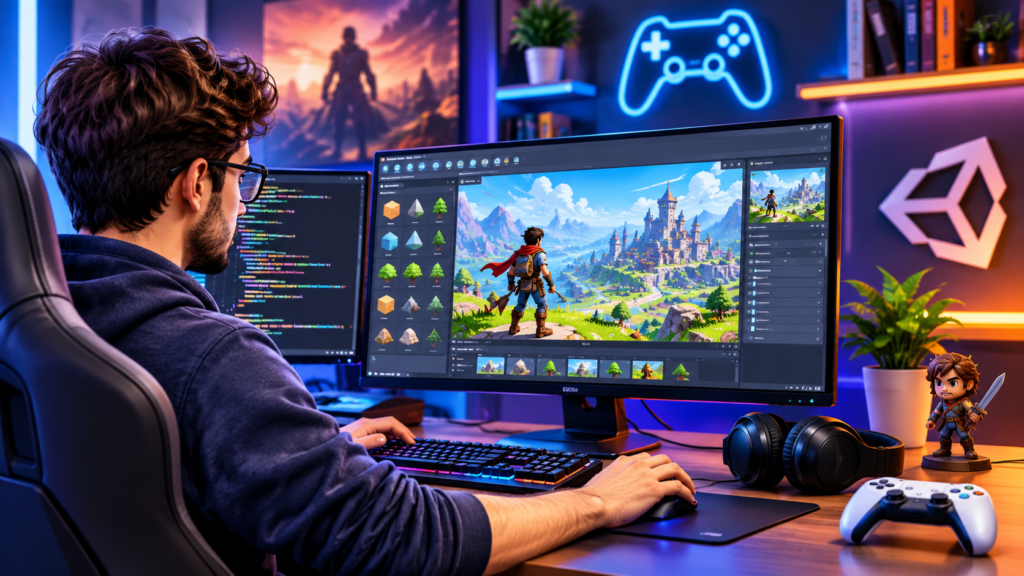
A game-making studio is where your idea stops being a daydream and becomes something you can actually play. It bundles the editor you click around in, the engine that makes everything move, and the tools that package it all up for players. Basically, it’s a movie studio, except the actors are sprites and nobody asks for a trailer.
Game engine vs. game creator studio
People use these terms as if they mean the same thing. They usually do, with one small difference. A game engine is the machinery under the hood: rendering, physics, input, and sound. A game maker studio wraps that machinery in a friendly editor with drag-and-drop tools, templates and export buttons, so you spend your time designing levels instead of writing a collision system at 3 a.m.
Unreal Engine and Godot are usually called engines, but both include full editors that handle everything a “studio” does. GameMaker, Roblox Studio and GB Studio lean harder into the beginner-friendly side. They’re built for people who’ve never written a line of code and would like to keep it that way for a while.
Who uses one?
More people than you would think:
- Hobbyists and students turning a weekend idea into something their friends can play (and roast).
- Indie developers shipping real, paid games on Steam, itch.io, mobile app stores and consoles.
- Teachers sneaking logic and problem-solving into lessons disguised as fun.
- Designers and content creators building prototypes, interactive stories and playable ads.
If you can describe your concept out loud, a game writer studio offers you a practical direction for building it.
Core Features Every Good Game Creator Studio Should Have
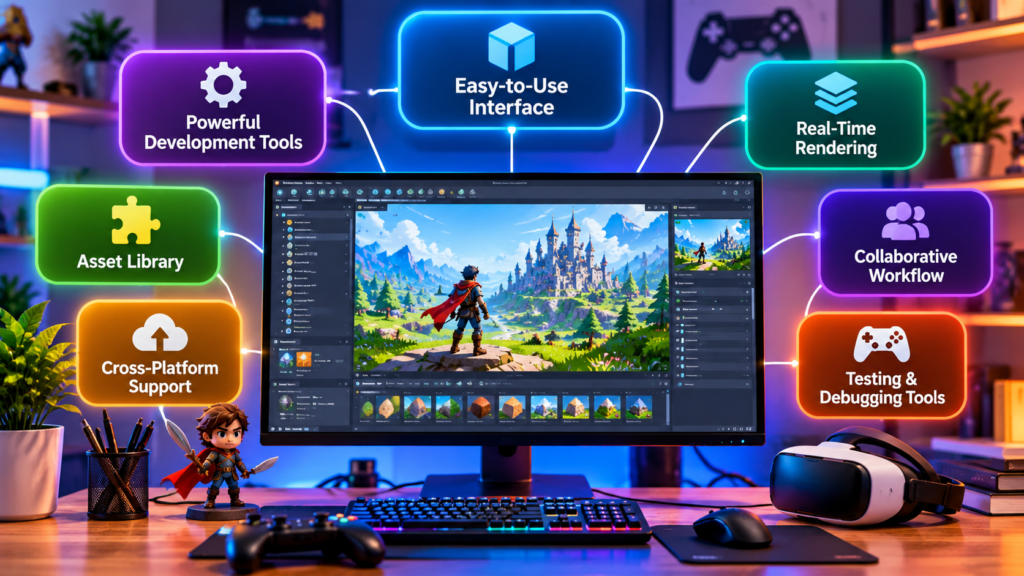
Every studio has a slick trailer. Trailers don’t finish games. These five features do.
Visual scripting or a friendly language
Game logic is the brain of your project: what happens when the player jumps, when an enemy touches them, or when the score goes up. A good studio gives you either visual scripting (snapping nodes or blocks together instead of typing) or a language that doesn’t look like a ransom note. Unreal has Blueprints. GameMaker has GML Visual alongside GML Code. Godot uses GDScript, which reads a lot like Python. Roblox Studio uses Luau. The best tools let you start visually and move on to code when you’re ready.
Scene and level editor
You should be able to drag things into a room, paint a few tiles, nudge the camera and hit Play. Instantly. That edit-and-test loop is the single biggest productivity boost you can get. If testing one tiny change takes five minutes, your motivation will pack its bags and leave.
Built-in physics, animation and audio
Gravity, collisions, sprite animation, particles and sound should just work out of the box. Building your own physics engine is a great learning exercise. It’s also a great way to never ship anything.
Multi-platform export
Check which platforms a studio can publish to before you fall in love with it. Windows, macOS, Linux, web, Android and iOS are common. Consoles are a different story: whatever tool you use, expect extra licensing plus approval from Sony, Microsoft or Nintendo.
Community, tutorials and asset store
When your character falls through the floor at 2 a.m., a big community is worth more than any shiny feature. Look for active forums, Discord servers, official tutorials, and an asset marketplace (like the Unity Asset Store or Epic’s Fab) where you can grab art, sounds, and scripts instead of making every single pixel yourself.
Popular Game Creator Studios Compared

There’s no “best” game development studio. There’s just the one that’s best for your game. Here’s how six popular picks stack up as of November 2026.
|
Studio
|
Best for
|
Scripting
|
Cost to start
|
Selling your game
|
| 2D games, fast prototyping | GML Code or GML Visual | Free (non-commercial) | $99.99 one-time Professional licence; console export needs Enterprise | |
| 2D and 3D, mobile, wide platform reach | C#, plus visual scripting | Free (Unity Personal) | Personal allowed up to $200,000 in annual revenue and funding; Pro above that | |
| High-end 3D visuals | C++ and Blueprints | Free | 5% royalty on a game’s lifetime gross revenue above $1 million | |
| Godot | 2D and 3D, open-source fans | GDScript, C# | Free | Free and open source (MIT licence), no royalties |
| Roblox Studio | Multiplayer games for an existing player base | Luau | Free | Earn Robux inside Roblox; games live on the Roblox platform |
| Retro Game Boy-style games | Drag-and-drop visual scripting | Free | Export real Game Boy ROMs and web builds |
GameMaker is the 2D veteran with receipts: Spelunky, Deltarune, and UFO 50 were all made with it. And there’s a plot twist coming. GameMaker says its next-gen runtime, GMRT, becomes free for commercial use on January 1, 2027, so you won’t need the paid licence to sell games built on it anymore (source).
Unity is still the go-to for mobile and mid-sized 3D projects. If you get stuck, someone has almost certainly made a tutorial about your exact problem.
Unreal Engine is where jaw-dropping 3D lives. Epic only takes a 5% royalty once a game earns over $1 million, and sales through the Epic Games Store are royalty-free. If you’re paying Epic, congratulations: you’re doing great.
Godot is lightweight, fully open-source, and costs exactly nothing, forever. That’s why so many indie developers have quietly moved in.
Roblox Studio hands you a massive multiplayer audience on day one, with no servers or marketing budget required.
GB Studio is pure joy for pixel-art fans: no code, and the result is a real Game Boy game.
How to Choose the Right Game Creator Studio for You
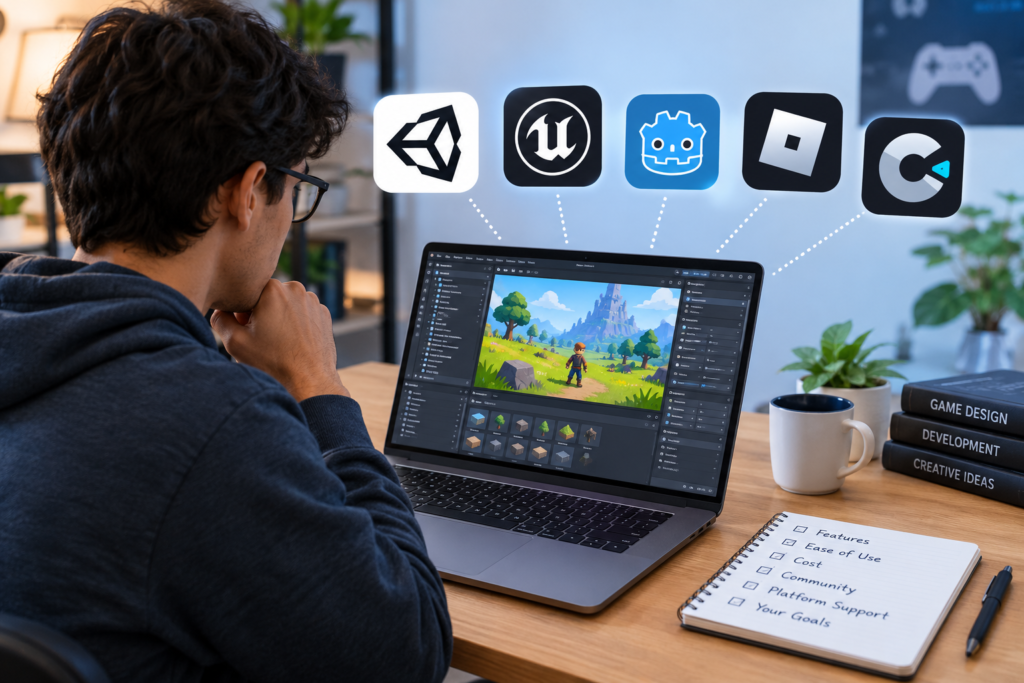
You can spend three weeks comparing engines, or you can answer four honest questions and get on with your life.
2D or 3D?
This is the big fork in the road. A 2D platformer, puzzle game, or top-down RPG is much faster to finish, and GameMaker, Godot and GB Studio shine here. If your idea needs 3D worlds, cameras, and lighting, look at Unity, Unreal, Godot, or Roblox Studio. Just know what you’re signing up for: 3D multiplies the work. Every model, rig, texture, and animation has to come from somewhere, and that somewhere is usually you.
Code or no code?
If the word “programming” makes your stomach drop, start visual: GB Studio, GML Visual or Unreal Blueprints. You’ll still learn real logic (variables, conditions, loops, events). You just won’t be staring at a wall of text while you do it. If you already know some code, Godot’s GDScript or Unity’s C# will feel like home and give you more control in the long run.
Budget and licensing
Almost every major studio is free to learn. The differences only show up once money gets involved. Some charge a one-time fee. Some take a cut after a threshold. Some want a subscription once your revenue or funding grows. And some, like Godot, charge nothing at all. Read the licence before you sell anything, not after your first payout lands.
Where you want to publish

Work backwards from where your players are. A browser game on itch.io? Most studios handle web export just fine. Google Play? Check Android export and mobile performance. Want an audience that’s already there? Roblox Studio publishes your game straight onto the Roblox platform, where people play on phones, tablets, PCs and consoles. Dreaming of consoles? Budget for extra licences and platform approval, no matter which tool you pick.
Conclusion
A game maker studio is the shortcut between someone should make this game and play my game. Which one you pick depends on what you’re building game maker or GB Studio for crisp 2D and retro projects, Unity for flexible cross-platform work, Unreal for 3D that makes people stop scrolling, Godot for a free, open-source route, and Roblox Studio for an audience that’s already waiting.
But honestly? The tool matters less than the habit of finishing. Start tiny. Prototype fast. Cut without mercy. Ship it, even if it’s a little embarrassing. One last thing before you sell anything: check the latest licence terms on the official site. Pricing in this industry changes fast, and GameMaker’s upcoming 2027 change is proof. Nobody wakes up planning to make a video game. But someone always ends up making one. Might as well be you.
FAQs
Can I make a game without coding?
Yes, really. GB Studio is built entirely around drag-and-drop visual scripting, and GameMaker (GML Visual) and Unreal Engine (Blueprints) let you build complete game logic without typing traditional code. You’ll still learn programming concepts like variables and conditions. They just show up as blocks and nodes instead of a scary text file.
Which game creator studio is best for beginners?
It depends on what you want to make. For 2D, GameMaker and Godot are beginner-friendly and very well documented. For a no-code retro project, GB Studio is the gentlest possible start. And if you want to make 3D multiplayer games with players already waiting, Roblox Studio is a strong first choice.
Can I earn money from games made in a free studio?
Usually, yes, but every studio has its own fine print. Godot is open-source and completely free, with no royalties. Unity Personal is free as long as your revenue and funding stay under $200,000 over the last 12 months. Unreal Engine is free until a game passes $1 million in lifetime gross revenue, and after that Epic takes 5% of anything above it. GameMaker currently needs a $99.99 Professional licence for commercial releases, though games built on its new GMRT runtime become free to sell from January 1, 2027. Always double-check the official licence page before launch day.