
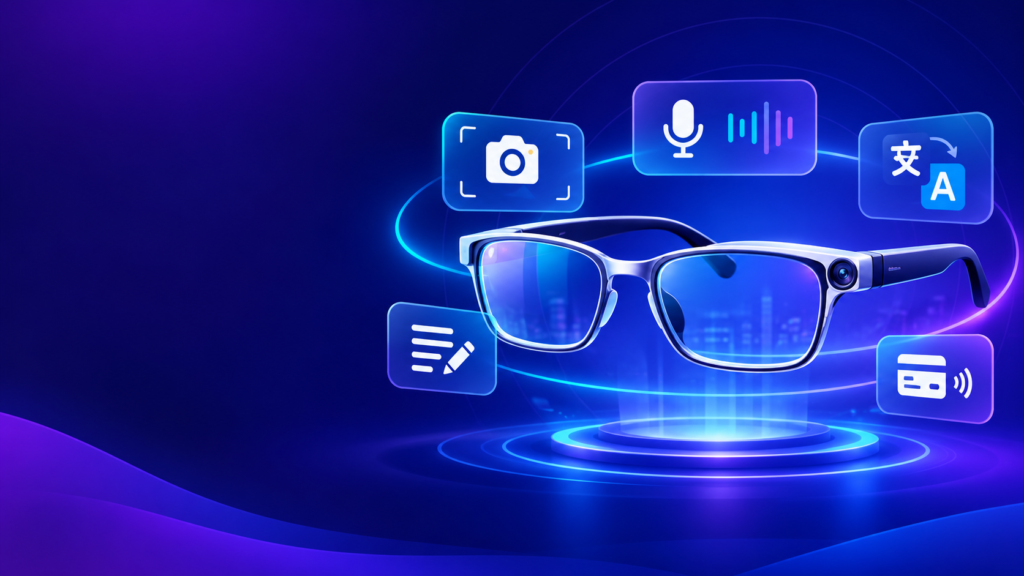
Introduction
Smart glasses are quickly becoming the next big battleground in consumer technology, and Alibaba has just made a serious move. The company has launched its Qwen Glasses N1 series, a line of AI-powered smart glasses designed to put an intelligent assistant on your face instead of in your pocket. Priced from 2,999 yuan, about $450 before discounts, they went on sale in China after a launch event in Hangzhou. What are the features of AI glasses? You can get all the details on tachcrunch.
But what do you actually get for that money? From a 50-megapixel camera to voice-driven shopping, payments, and even eye tracking on the higher-end model, these glasses pack a lot into a familiar frame. This guide walks through every major feature, how the glasses stack up against rivals, where they fall short, and who they suit best, so you can judge whether the hype is justified.
Note on prices: dollar figures in this guide are approximate and use a single conversion rate of roughly 6.7 yuan per US dollar throughout.
What Are The Feature Alibaba’s Qwen Glasses N1?
The Qwen Glasses N1 are the newest entry in Alibaba’s push into consumer hardware, a field where the company has historically been a rare player. They arrive roughly a year after Alibaba’s first-generation Quark AI Glasses and integrate the Qwen AI assistant more tightly, with expanded functionality. Both models are screenless: there is no display in the lenses, and the assistant responds through audio.
The lineup has two tiers:
- Qwen Glasses N1: goes on sale at 2,999 yuan (about $450).
- Qwen Glasses N1 Pro: costs 3,499 yuan (about $525), roughly $75 more than the base model. It adds eye tracking, iris scanning for payments, and sensors for heart rate, blood oxygen, and skin temperature.
The strategy is simple. Alibaba, mirroring Meta, wants smart glasses to be an entry point to its AI tools and agents. In other words, the glasses are as much a gateway to the Qwen ecosystem as they are a gadget.
What Are the Key Features of Alibaba’s $450 AI Glasses
1. A 50-Megapixel Point-of-View Camera
The camera is the headline hardware upgrade. The N1 series has 50-megapixel cameras that capture photos and videos from your point of view without reaching for a phone. For travelers, creators, and anyone who wants to record a moment hands-free, that is a significant draw. A high-resolution sensor can also give the AI more detail to work with, which matters because the assistant is meant to understand what you are looking at. In practice, how much of that detail reaches the assistant in real time depends on bandwidth, processing, and battery limits, so image quality alone does not guarantee smarter answers.
2. Qwen AI Assistant Built In
At the center of the experience is Alibaba’s Qwen assistant. By linking the glasses to Qwen models and Alibaba’s wider ecosystem, the company wants its AI to understand a user’s surroundings and access relevant services.
Think of it as a context-aware helper. You glance at something, ask a question, and the assistant responds using what the camera sees and what Alibaba’s services can do.
3. Bone-Conduction Microphones for Voice Control
Talking to an assistant in public can be awkward, so the hardware matters. Users can interact with the AI agent through bone-conduction microphones, which pick up speech through skull vibrations rather than relying solely on airborne sound. The main benefit is clarity: voice commands should be recognized more reliably in loud places. Privacy gains are limited. If you speak at a normal volume, people nearby can still hear you; the sensors only help if you choose to speak more quietly.
4. Voice Translation and Meeting Notes
Practical productivity features round out the assistant. Imagine sitting in a multilingual meeting and getting translation support without holding up a phone, or having your conversation transcribed and summarized afterward. These are the use cases that make smart glasses feel useful rather than gimmicky.
5. Shopping and Payments
Alibaba is, at heart, a commerce giant, so it is no surprise that shopping is baked in. The vision is easy to grasp: see a product, ask the AI about it, and complete a purchase, all without touching a screen. This is where the glasses lean hardest on Alibaba’s retail and payments empire, and where competitors without such an ecosystem may struggle to match them. Rivals in China that already support Alipay or use Qwen models will be closer competitors on this front. Iris-verified payments, however, require the N1 Pro.
6. Eye Tracking and Iris Payments (Pro Model)
The N1 Pro goes a step further. The Pro edition, priced at 3,499 yuan, adds eye tracking, so you can look at an object to ask about it. It also supports iris scanning to confirm payments.
Eye tracking could let the glasses understand where your attention is focused, making interactions more natural. Iris-based payment verification adds a biometric security layer that few mainstream smart glasses offer today.
7. Health and Wellness Sensors (Pro Model)
The Pro model also doubles as a basic wellness monitor. The premium glasses can monitor indicators including heart rate, blood oxygen, and skin temperature, though these are presented as wellness features rather than independently validated medical diagnostics. That distinction matters. Treat the readings as general insights, not a substitute for medical devices.
8. Battery Life
Battery is often the Achilles’ heel of smart eyewear. The glasses promise up to 25 hours of standby time, or nine hours of music playback, on a single charge. Launch coverage also describes swappable batteries, which could help with long days. Standby figures are always more flattering than real-world use, so expect shorter runtimes if you shoot lots of video or lean heavily on the AI.
Bonus: Qwen Clip Earbuds
Alongside the glasses, Alibaba announced a companion product. Qwen Clip, AI-powered earbuds developed with Bose, are priced at 1,299 yuan (about $195). Together, the glasses and earbuds show Alibaba is building a wearable AI family rather than a single product.
How Do They Compare to Meta and Alibaba’s Earlier Glasses?
Versus Meta’s Ray-Ban glasses
Alibaba is not trying to win on price. At about $450 before discounts, the N1 costs roughly the same as Meta’s newest Ray-Ban Meta (Gen 3), which starts at $449. Older Meta generations start lower, at $379 for Gen 2 and $299 for Gen 1. On hardware, the N1’s 50-megapixel camera is well above the 12-megapixel sensor in the Gen 2.
The bigger difference is the ecosystem. Meta’s glasses are built around Meta AI, while the N1 is built around Qwen, Taobao, and Alipay. Meta’s services are not officially offered in mainland China, where the N1 is on sale, so its more relevant rivals there are Chinese AI glasses from makers such as Xiaomi, Baidu, and Rokid. Check their current prices and features before buying.
Versus the original Quark glasses
Alibaba’s first glasses came in two models: the Quark S1, starting at 3,799 yuan (about $570) with dual micro-OLED displays, and the lightweight, display-free Quark G1, starting at 1,899 yuan (about $285). The N1 sits between them on price, but “cheaper” is the wrong way to read it. The N1 is screenless like the G1, so its 2,999-yuan price is about 58% above the G1’s, though it adds a 50-megapixel camera.
It is 800 yuan below the S1, but it has no display, which was the S1’s main feature. The N1 Pro, at 3,499 yuan, comes close to the S1’s price while adding eye tracking, iris payments, and wellness sensors instead of a display. Treat the N1 series as a different bet on camera, voice, and biometrics rather than a cheaper Quark.
Limitations to Consider
No product is perfect, and these glasses come with caveats:
- Limited availability. Launch reports describe sales in China, so international buyers should not assume global availability.
- Real-world constraints. Practical limits include battery drain during video recording, voice recognition in noisy settings, and the availability of supported payment systems.
- Ecosystem dependence. Much of the value comes from Alibaba’s services. Outside that ecosystem, the benefits shrink.
- Wellness, not medical. Health readings are informational, not diagnostic. Sensors in eyewear can also be affected by fit and movement.
- Privacy questions. Any camera-equipped wearable raises concerns about recording others and handling sensitive biometric data, such as iris scans. Launch coverage did not detail where biometric data is stored or processed, and independent assessments of the safeguards were not available at launch. Buyers should look for that information before enabling iris payments.
Who Should Care About These Glasses?

These glasses suit several groups:
- Alibaba ecosystem users who already shop on Taobao or Tmall and pay with Alipay. Most of the value comes from those integrations.
- Frequent travelers and professionals who want hands-free translation and meeting notes. The standard N1 covers these.
- Content creators who want hands-free, first-person capture. Test real-world battery life first, since video drains it faster.
- Early adopters curious about eye tracking and iris payments. These are Pro-only features.
Which model? The N1 Pro costs 500 yuan more, roughly $75. That buys eye tracking, iris-verified payments, and heart rate, blood oxygen, and skin temperature sensors. Pay it only if you will use those features. If you mainly want the camera, assistant, translation, and notes, the standard N1 does all of it. Subsidies and launch offers can bring the starting prices down to about 2,218 yuan for the N1 and 2,600 yuan for the Pro.
Before you buy, confirm with the seller whether the glasses are comfortable for long wear and support prescription lenses, which phone platforms and Alibaba apps they work with, and how you feel about the camera and biometric data.
If you want the cheapest option or live outside supported regions, you may want to wait for broader availability and independent reviews.
Conclusion
Alibaba’s Qwen Glasses N1 series is a bold statement of intent. For about $450, buyers get a 50-megapixel camera, a voice-driven Qwen assistant, translation, meeting notes, shopping, and payments. The 3,499-yuan N1 Pro (about $525) adds eye tracking, iris-based authentication, and wellness sensors. It is a package built to make AI feel ambient rather than app-bound.
Still, real-world performance will decide everything. Battery life, voice recognition in noisy places, regional availability, and privacy concerns are open questions, and the glasses are no cheaper than Meta’s newest Ray-Ban offering. If Alibaba delivers on its promises, these glasses could become a compelling doorway into its AI ecosystem. For now, they are an exciting, promising product worth watching closely as reviews and wider launches arrive.
FAQs
1. How much do Alibaba’s new AI glasses cost?
The base Qwen Glasses N1 starts at 2,999 yuan, roughly $450, before discounts. The N1 Pro, which adds eye tracking and extra sensors, costs 3,499 yuan, roughly $525. Prices are quoted for China, so final costs elsewhere, if the glasses ever launch there, could differ.
2. What is the difference between the N1 and the N1 Pro?
Both feature the 50MP camera and Qwen AI integration. The Pro adds eye tracking, iris scanning for payments, and health sensors that measure heart rate, blood oxygen saturation, and skin temperature. If you want biometric and wellness features, the Pro is the one to pick. For everyday AI assistance, photos, and translation, the standard N1 covers the essentials.
3. Are Alibaba’s AI glasses better than Meta’s Ray-Ban glasses?
It depends on what you value. Alibaba’s strengths are deep AI integration with shopping, payments, and its broader ecosystem, plus eye tracking and health sensing on the Pro. Meta has a more established presence and a familiar design. Because the N1’s price is close to Meta’s newest Ray-Ban glasses, the choice comes down to ecosystem, availability, and which features matter most to you. Independent hands-on reviews will give a clearer verdict.