

Most companies say they listen to their customers. Far fewer let customers help build the product.
That second approach is called user co-creation, and it’s one of the cheapest ways to avoid building something nobody wants. At TachCrunch we cover a lot of startup launches, and the ones that survive usually have one habit in common: they stay close to the people who use their product.
This guide explains what user co-creation is, how it differs from ordinary feedback, and which brands do it well. You’ll also get a simple five-step plan, the mistakes to avoid, and a reading list if you want to go deeper.
What Is User Co-Creation?
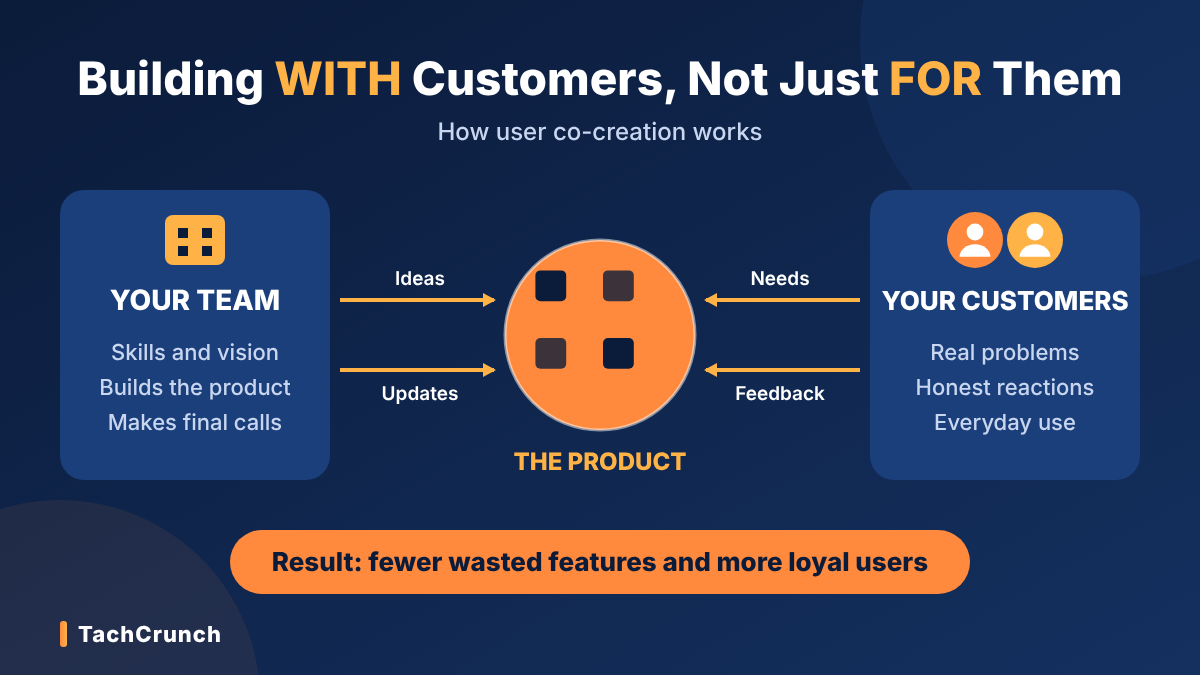
User co-creation is a product development approach where customers take an active part in designing a product, feature, or service, from the first idea to the final version. Instead of answering a survey after launch, they help define the problem, react to early drafts, and shape what gets built.
Researchers C.K. Prahalad and Venkat Ramaswamy helped popularize the idea in the early 2000s. They argued that value shouldn’t be handed to customers finished. It should be created together with them.
Think of a neighborhood restaurant. A chef who works alone picks the menu and hopes it sells. A chef who co-creates tries a new dish on a few regulars, listens, changes the seasoning, and only then puts it on the menu. The food ends up better, and the regulars feel like it’s partly theirs.
User Co-Creation vs. Customer Feedback vs. User-Centered Design
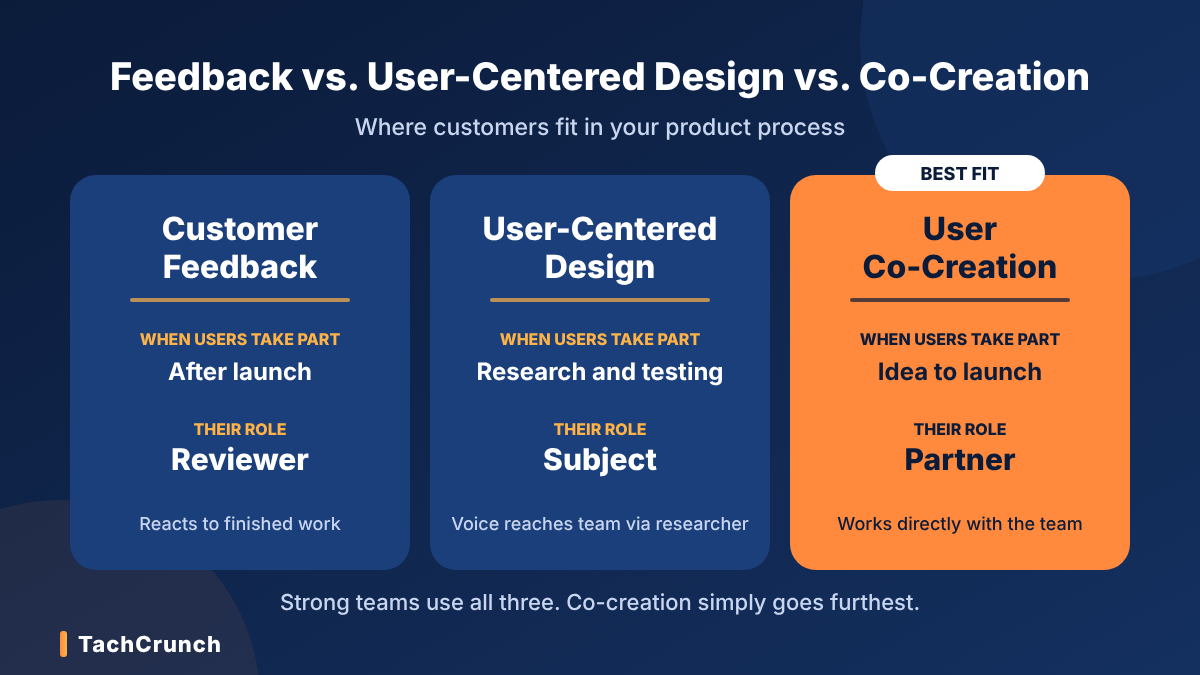
People often mix these three up, so here is the difference.
Customer feedback comes after the fact. Someone uses the product, then tells you what they thought. It’s useful, but the work is already done.
User-centered design keeps the user’s needs at the center. A researcher studies users and passes the findings to designers, so the user’s voice arrives through a middle layer.
User co-creation removes that middle layer. Customers work directly with the team. They might join a design session, vote on ideas, test a prototype, or submit their own concepts.
| Approach | When users take part | Their role |
|---|---|---|
| Customer feedback | After launch | Reviewer |
| User-centered design | Research and testing | Subject |
| Co-creation | Idea to launch | Partner |
You don’t have to pick one. Good teams use all three. Co-creation goes furthest.
Examples of Customer Co-Creation in the Real World
Theory only goes so far, so look at what actual companies do.
LEGO Ideas. Fans submit their own set designs on a public platform. When a design gathers 10,000 supporters, LEGO’s team reviews it, and some designs become real products. The fans bring the imagination, and LEGO handles manufacturing and safety.
Threadless. This T-shirt company built its model on community artwork. Members submit designs, other members score them, and the winners get printed. The audience helps choose the inventory before it exists.
IKEA Hackers. This fan-run site, which IKEA doesn’t operate, collects clever modifications of IKEA furniture. It proves a point: customers want to create, even when no company asks them to.
Open-source software. Linux and WordPress improve because thousands of users fix bugs, write features, and help each other. Users also build the product.
Public roadmaps and beta programs. Many software companies share what they plan to build and let users vote or test early versions. AI tools follow a similar loop. When we looked at how Anthropic’s Claude Ship agents review and approve code changes, the common thread was constant feedback between the tool and the people using it.
None of these examples needed a giant research department. They needed openness and a real willingness to listen.
Benefits of User Co-Creation
You solve problems people actually have
Your customers live with your product every day. They know which steps annoy them and what they do to work around your design. When they describe their routine in their own words, you find needs that never appeared in your planning documents.
You waste less money.
Building the wrong feature is one of the costliest mistakes a young company can make. Early reactions catch bad assumptions while they’re still cheap to fix, back when they’re a sketch instead of finished code.
You earn loyalty
People who help shape a product feel some ownership over it. They recommend it, defend it, and forgive small flaws. Advertising has a hard time buying that.
You improve in small, safe steps.s
A giant redesign is a gamble. Co-creation gives you a steady stream of small corrections instead, each one low risk. Over a year, they add up to real product improvement.
You stay relevant
Markets move fast. We recently covered companies that have already replaced workers with AI, and one lesson stands out: automation can speed up production, but it can’t tell you what customers will want next. Talking to them can.
How Do You Start With User Co-Creation? A 5-Step Plan
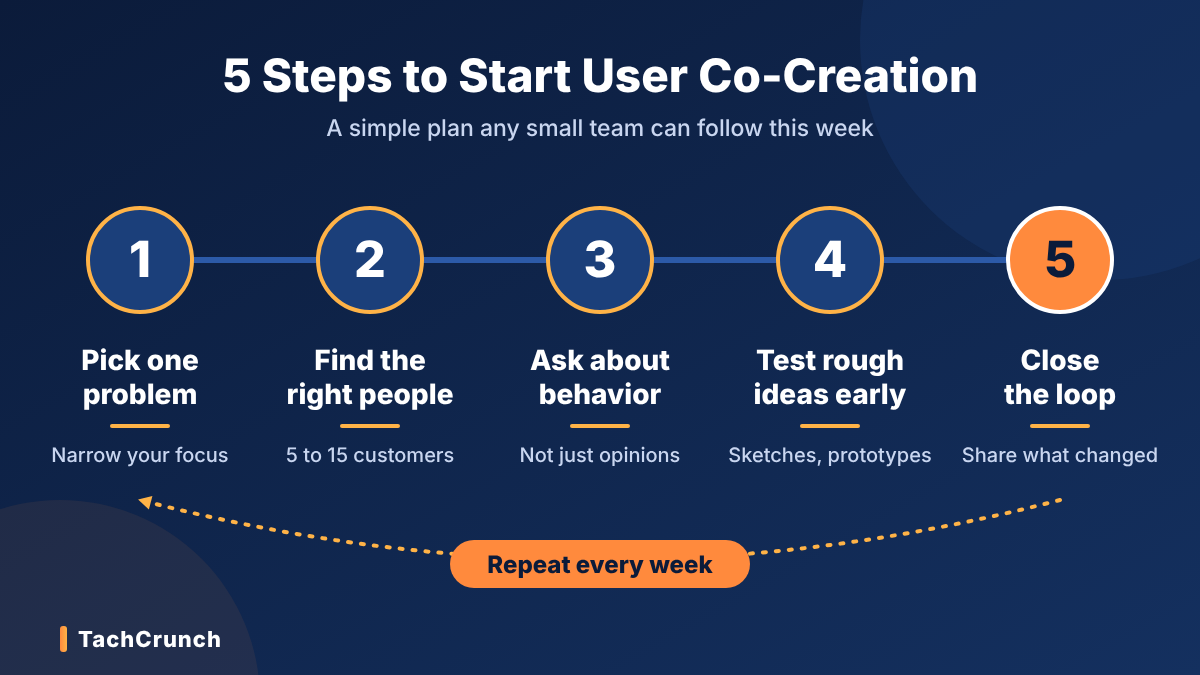
You don’t need a workshop budget. You need a clear plan and some discipline.
Step 1: Pick one problem
Don’t try to co-create the whole product. Choose one area, such as onboarding, search, pricing, or a single feature. A narrow focus keeps sessions useful and makes results easier to measure.
Step 2: Find the right people
Aim for five to fifteen participants who match your target audience. Include a few honest critics. People who agree with everything teach you very little, and your loudest fans are rarely typical customers.
Step 3: Ask about behavior, not opinions
How you phrase a question matters more than most people expect. “Would you use this?” gets a polite yes. “Tell me about the last time you tried to do this” gets a real story.
Questions that work well:
- How do you handle this today?
- What was the most annoying part?
- What did you try before that failed?
- What do you do when it goes wrong?
Pay attention to workarounds. Every workaround points to a need your product doesn’t meet yet.
Step 4: Test rough ideas early
Show sketches, mockups, or a clickable prototype. Rough work tells people that nothing is final and honest criticism is welcome. Polished work makes people hold back. At this stage you want reactions, not applause.
Step 5: Close the loop
Most teams skip this step, and it matters most. Tell participants what you changed because of their input. Also tell them what you chose not to change, and why. When people see their words turn into action, they keep helping. When they hear nothing, they quietly stop replying.
Common User Co-Creation Mistakes
Collecting feedback and ignoring it. If nothing visibly changes, participation drops and trust goes with it.
Treating every request as an order. Users describe their problems well, but they’re not always good at designing the fix. Take the pain seriously and keep the job of solving it.
Listening only to the loud ones. A few vocal users can dominate your inbox. Go out of your way to reach the quiet majority.
Trusting words over behavior. What people say they’ll do and what they actually do often differ. Watch behavior whenever you can.
Designing by committee. Co-creation doesn’t mean every idea gets built. Someone still has to decide and keep the vision clear.
Running it once. One workshop is a fine start, but the value comes from repeating it.
Tools for Co-Creation With Customers
You can start with almost nothing:
- Short video calls for one-to-one interviews
- Public roadmaps and voting boards
- A small private community for engaged users
- Beta groups with early access
- One-question prompts inside your app
- A shared spreadsheet for themes, quotes, and decisions
The tool matters less than the routine. A spreadsheet and a weekly conversation beat an expensive platform nobody opens.
User Co-Creation on a Small Budget
Co-creation is one of the cheapest forms of research there is. Ten customer conversations cost you time, not money. If you haven’t settled on what to build yet, our list of low-capital, high-profit small business ideas is a good place to begin, and you can test any of them with real people before spending much.
If you need money for research or prototypes, see our roundup of small business grants to apply for in November 2026. More guides like this live in the TachCrunch Business section.
Best Books on Product Development and User Research
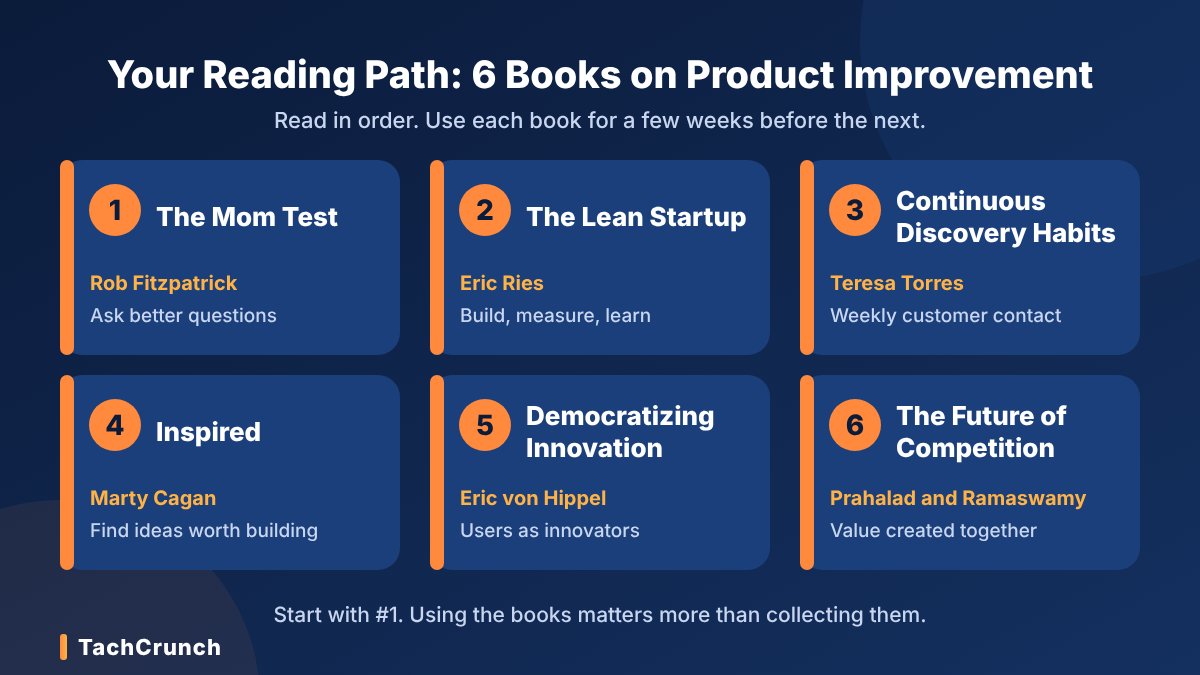
Read these in order. Each one builds on the one before.
- The Mom Test by Rob Fitzpatrick: how to ask questions that get honest answers. Start here.
- The Lean Startup by Eric Ries: build, measure, and learn in small cycles.
- Continuous Discovery Habits by Teresa Torres: how to make weekly customer contact routine.
- Inspired by Marty Cagan: how strong product teams find ideas worth building.
- Democratizing Innovation by Eric von Hippel: research on how users become a source of innovation.
- The Future of Competition by C.K. Prahalad and Venkat Ramaswamy: the classic text on creating value with customers.
Read one, use its ideas for a few weeks, then move on. Owning a shelf of books feels productive. Using them is what changes your product.
FAQs About What Is User Co-Creation
Is user co-creation only for big companies?
No. Small teams often do it better because they can talk to customers directly, with no layers in between.
How is it different from customer feedback?
Feedback arrives after launch and reacts to a finished product. Co-creation brings customers in before and during development.
How many users do I need?
Fewer than you’d think. Five good conversations can show clear patterns. Add more when the answers stop surprising you.
Does it slow development down?
A little at the start. It usually saves far more time by preventing rework.
Can I do it online?
Yes. Video calls, shared documents, private communities, and voting boards all work well, especially for remote audiences.
What if customers ask for something I can’t build?
That happens a lot. Look past the request to the problem behind it. There’s often a simpler fix that fits your resources.
Conclusion: What Is User Co-Creation
User co-creation isn’t a buzzword. It’s a habit of staying close to the people you serve. The teams that do it well don’t have secret tools or huge budgets. They ask good questions, test rough ideas, and tell customers what changed.
Start small. Pick one problem, talk to five real users this week, and act on what you hear. Then repeat it next week. Your product will get better, and your customers will notice that someone listened.
For more practical business guides, keep reading TachCrunch.