
Futurepedia is a free AI tools directory with paid courses and paid tool listings, based in Utah and now owned by HubSpot. It is a good place to start finding AI tools, but test any tool yourself before you pay.
Key takeaways
- Browsing the directory and two starter courses are free.
- HubSpot acquired Futurepedia in April 2026 and says it stays editorially independent.
- Prices online conflict, so confirm on the official site before buying.
- Tool makers pay to be listed, so use the directory as a shortlist, not a final verdict.
New AI tools launch every week, and no one can keep up alone. If you run a small business, work in marketing, or just want to try AI at work, a directory like Futurepedia saves hours of searching.
Welcome to TachCrunch, your home for tech, AI, and business news. We cover AI products as they launch, like Anthropic’s Claude Ship agents, so we know how crowded the market has become.
Futurepedia also had a big year. In this review, we cover what it does, what it costs in US dollars, what the HubSpot deal changes, and who should skip it.
What Is Futurepedia?
Futurepedia is an AI tools directory with an education arm: YouTube channels, a newsletter, and online courses. You browse tools by task, compare them, and learn how to use them.
The directory lists thousands of AI tools you can filter by category, pricing, and use case, with short summaries and ratings on each listing. One data source counts 29 categories, including chatbots, code assistants, image generation, video, marketing, and AI agents. Futurepedia does not seem to publish an exact tool count, so be careful with any specific number you read elsewhere.
Futurepedia at a glance
| Fact | Detail |
|---|---|
| Founded | 2022 |
| Based in | Park City, Utah, US |
| Owner | HubSpot (since April 2026) |
| Main products | Directory, courses, YouTube, newsletter |
| Cost to browse | Free g2g2 |
Futurepedia Timeline: 2022 to 2026
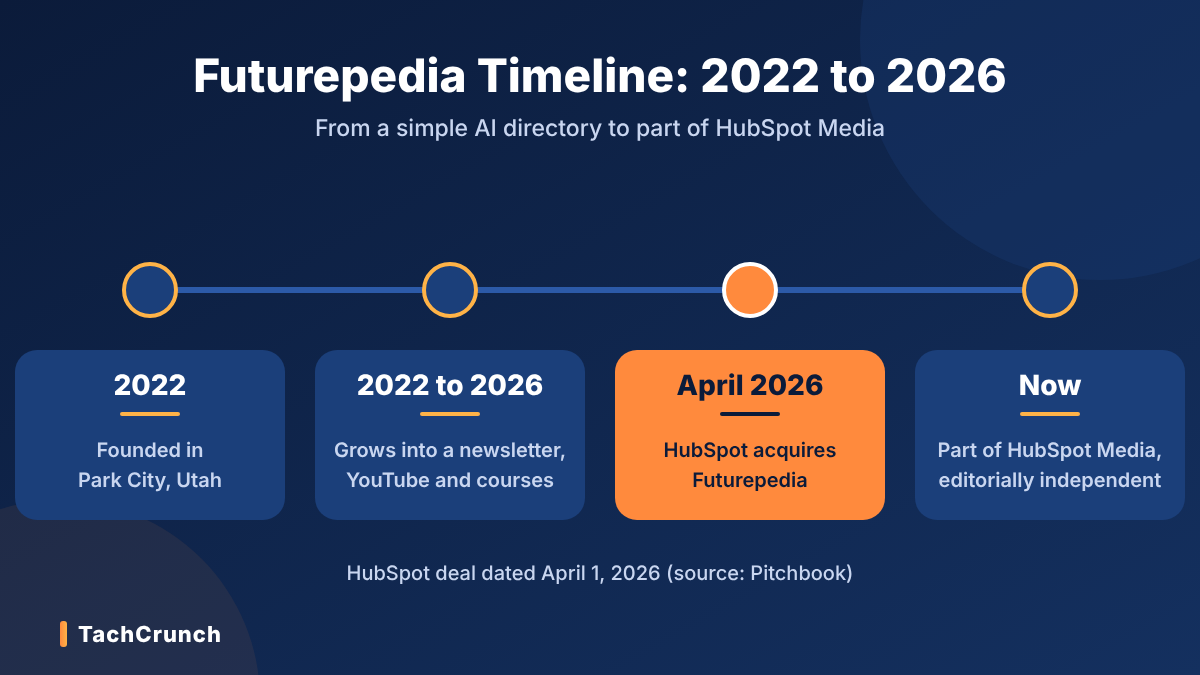
- 2022: Futurepedia is founded in Park City, Utah.
- 2022 to 2026: The brand grows beyond a directory into a newsletter, a YouTube network, and an education platform.
- April 2026: HubSpot’s acquisition of Futurepedia is dated April 1, 2026.
- Now: Futurepedia says it plans more video, newsletter, and web projects as part of HubSpot Media.
What Changed in 2026: HubSpot Buys Futurepedia
Most older reviews miss this. HubSpot got a 17-channel YouTube network, a newsletter, and an education platform of about 1,000 lessons. Axios reported that the purchase speeds up HubSpot’s AI content strategy and expands its creator program. contentmarketinginstituteAxios
HubSpot is a Massachusetts-based marketing and sales software company, so this is a US deal between two US businesses. Futurepedia told its audience it is joining HubSpot Media, will remain 100% editorially independent, and plans more content, education, and community across video, newsletter, and web. You can read the official announcement yourself. Axios also covered it in a piece on brand media deals.
What it means for you
- More content. More videos, lessons, and newsletters are the stated plan.
- More business focus. Expect more marketing and sales use cases, since that is HubSpot’s world.
- Reasonable skepticism. “Editorially independent” is a promise. When a tool review sounds like an ad, cross-check it.
Futurepedia Features
AI tools directory
This is the core product. Pick a category, filter by price or use case, and scan short descriptions and ratings. It works best when you know the job (“transcribe meetings,” “edit video”) but not the tool.
AI courses and prompt library
Futurepedia also sells learning. The free Starter Access tier includes two courses (AI Boot Camp and Prompting Essentials), workbooks, and a certificate, with no credit card needed. The paid all-access plan adds 30+ courses, 1,000+ lessons, 5,500+ prompts, downloadable guides, and a private community. That course list comes from a third-party listing, so verify it on the official site. siteefy
YouTube and newsletter
A lot of Futurepedia’s reach comes from short video tutorials and a regular email digest. Watching a tool in action often teaches more than a written description, and this is the best free part of the brand for many people.
Futurepedia Pricing in 2026 (USD)
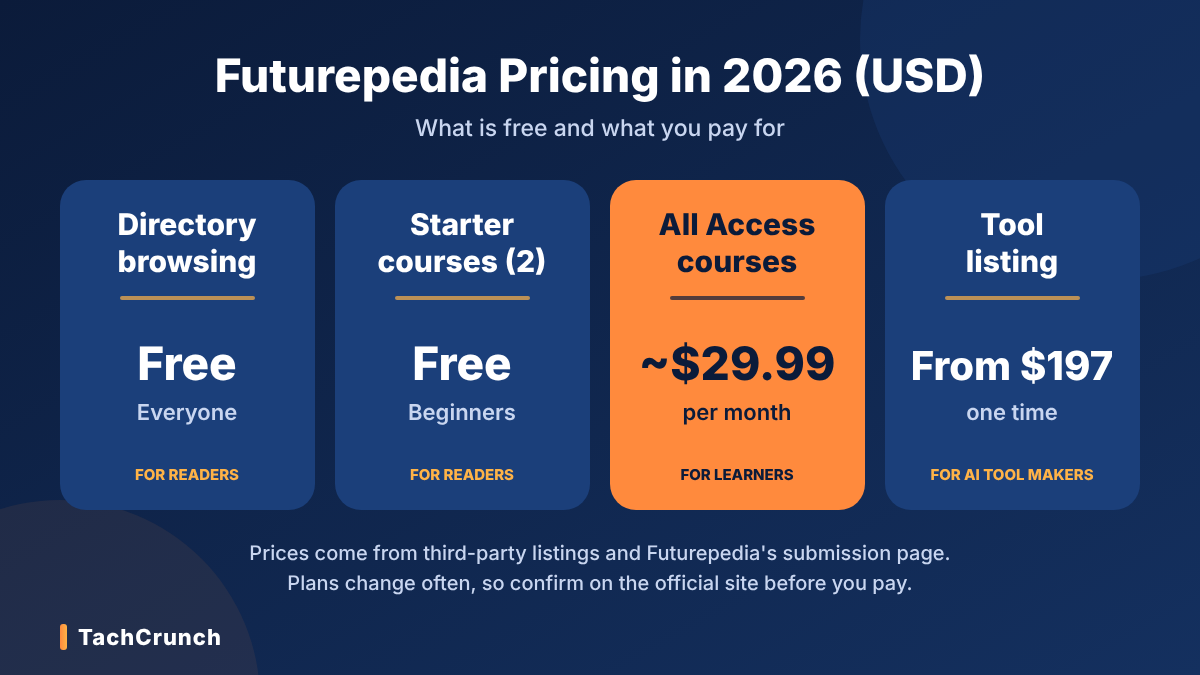
Browsing is free. Paid options depend on whether you are a learner or a company listing a tool.
| What | Price (USD) | Who it is for |
|---|---|---|
| Directory browsing | Free | Everyone |
| Starter Access (2 courses) | Free | Beginners |
| Monthly All Access | About $29.99 per month | Learners wanting the full library |
| Tool submission | $197 one-time (official page) | AI tool makers |
| Verified or enhanced listing | $247 or $497, depending on the source | AI tool makers |
Pricing is the messiest part of the research. One review notes the enhanced listing shows $497 in its heading but $247 in its description. Another source says free submissions ended and the cheaper tier sold out, leaving $497 as the real entry price. Other sites quote monthly fees as low as $1 to $6, which do not match the course pricing above. Plans change often, so treat every number as “check before you pay.” aitoolsrecapsubmitmap
Is Futurepedia free? For readers, mostly yes. Paid products are the all-access courses and, for companies, tool listings.
How Does Futurepedia Make Money?
A free directory still has costs, so it helps to know how Futurepedia pays for itself. There are three main sources.
- Tool listings. AI companies pay a one-time fee to submit their tool, starting at $197 on the official page.
- Courses. The all-access plan is a paid subscription for learners.
- Sponsorships and partnerships. A third-party listing describes custom enterprise packages with sponsorship bundles, webinars, editorial content, and YouTube campaigns.
This is common for media sites and is not a problem by itself. It just means you should read recommendations with that in mind, especially now that the brand sits inside a larger company.
How to Use Futurepedia Step by Step
- Start with the task. Open the category that matches the job you need done.
- Filter by price. Select free or freemium if you are on a tight budget.
- Shortlist three tools. Open each and try the free plan for 15 minutes.
- Check the last update. AI tools change fast so a stale listing may be wrong.
- Watch one tutorial. A short video shows a real workflow better than a summary.
- Take the free courses. They are a low-risk way to build skills employers now want, especially as companies replace workers with AI.
How to Judge an AI Tool Before You Pay
A directory listing is only a starting point. Before you enter a credit card, check these six things:
- Free trial or free plan. Can you test it on a real task first?
- Total price in USD. Look for per-seat fees, usage limits, and add-ons.
- Cancellation rules. Find out if it auto-renews and how to cancel.
- Privacy policy. See what happens to the files and customer data you upload.
- Data export. Make sure you can take your work with you if you leave.
- Support and updates. Look for a recent update date and a real contact option.
Tips for US Readers and Small Businesses
- Watch your budget. If you own a small business, start with free tiers and the free courses before you pay for anything.
- Check data handling. If a tool will touch customer data, read its privacy policy and see where data is stored. Laws such as California’s CCPA may apply to your business, so ask a qualified professional if you are unsure.
- Test before you subscribe. A directory listing is not an endorsement. Use trials and cancel before auto-renewal if the tool does not help.
- Compare in dollars. Many AI tools bill monthly in USD, so add up your subscriptions before several small ones turn into a large bill.
Common Mistakes When Using an AI Directory
- Trusting star ratings alone. Short ratings tell you little about your own workflow.
- Choosing by feature list. A long feature list does not mean the tool fits your task.
- Signing up for annual plans too early. Start monthly until you know the tool works.
- Ignoring free-plan limits. Some free plans cap usage so low that they are only demos.
- Collecting too many tools. Pick one or two and learn them well.
Pros and Cons
Pros
- Large, searchable directory with practical filters
- Free browsing and two free starter courses
- Strong video content for visual learners
- Backed by a large US company, so it is unlikely to disappear
Cons
- Tool makers pay to be listed, so it is not a neutral ranking
- Pricing information online is inconsistent
- Short descriptions mean you still need to test tools yourself
- Some reviewers note noise: the biggest friction point is the signal-to-noise ratio, with the occasional low-quality tool.
Is Futurepedia Legit and Trustworthy?
It appears to be a real, established business. It has a Utah business address and has been public since 2022. On Trustpilot, one page shows a TrustScore of about 4.8, but a reviewer there notes that Futurepedia emailed to ask for reviews and that the newsletter may include sponsored links. Many reviews praise the content itself, especially the YouTube tutorials and a newsletter that is easy to digest. Futurepedia Bewertungen 103 +2
Read that praise as a sign the content is useful, not proof that every listed tool is good. Reviews that a company requests tend to lean positive, so weigh them with care.
Should You List Your AI Tool on Futurepedia?
If you build AI products, it is worth considering. The submission page claims 400K+ monthly visitors, accepts AI tools only, rejects NSFW tools, and offers a refund if your tool fails editorial review. Keep expectations realistic. One analysis says outbound links from the directory are nofollow, so they pass little SEO value. Treat a listing as a way to be discovered by readers, not a link-building shortcut. The official submission page has current terms.
Futurepedia Alternatives
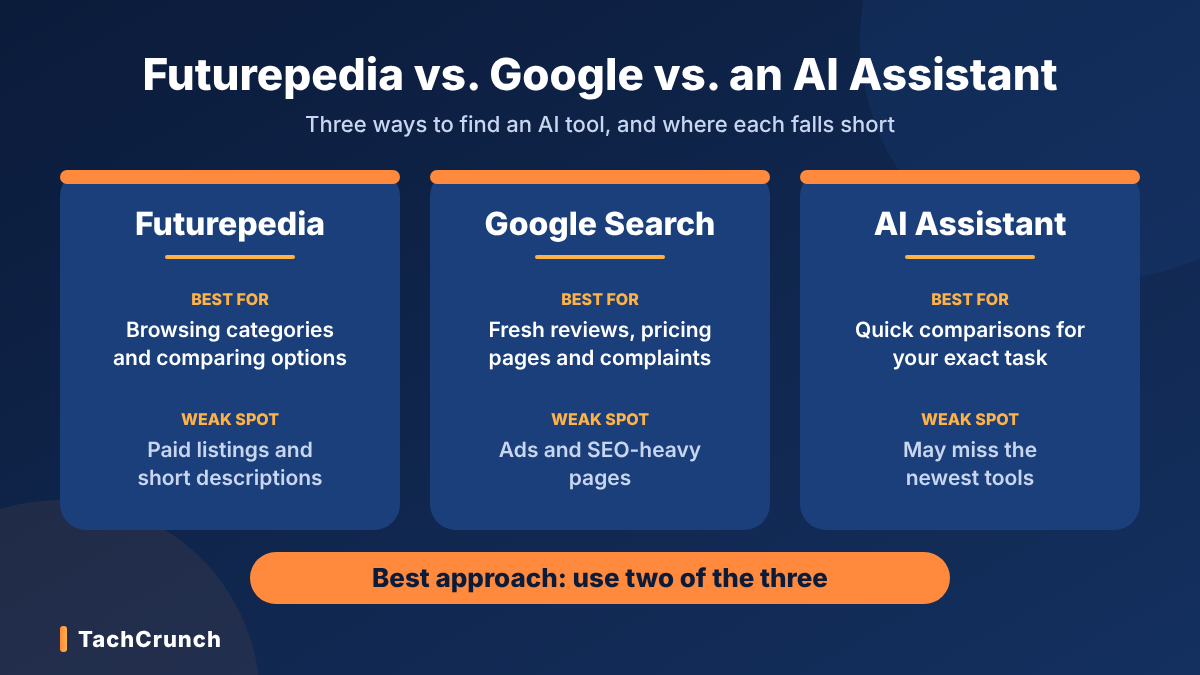
Future Tools and AI Valley are often named as alternatives. You can also ask an AI assistant to compare tools for your task, then test the shortlist.
Futurepedia vs. Google vs. an AI assistant
| Method | Best for | Weak spot |
|---|---|---|
| Futurepedia | Browsing categories and seeing options side by side | Paid listings, short descriptions |
| Google search | Fresh reviews, pricing pages, user complaints | Ads and SEO-heavy pages |
| AI assistant | Quick comparisons for your exact task | May miss the newest tools |
The best approach is to use two of the three. Find options on Futurepedia, then check reviews and pricing on Google. No directory replaces hands-on trials.
Who Is Futurepedia Best For?
- Beginners who want to see what AI tools exist
- Marketers and small business owners who need practical tools fast
- Learners who like structured, short lessons
- AI founders who want to be discovered
Skip it if you need deep technical benchmarks or completely unpaid, independent rankings.
FAQs
What is Futurepedia?
An AI tools directory with courses, YouTube channels, and a newsletter, now part of HubSpot Media.
Is Futurepedia free?
Browsing and two starter courses are free. All-access courses and tool listings are paid.
Who owns Futurepedia?
HubSpot acquired it in April 2026. Futurepedia says it remains editorially independent.
How much does Futurepedia cost?
Third-party listings show about $29.99 a month for all-access courses and $197 or more for tool listings. Confirm on the official site.
Where is Futurepedia based?
In Park City, Utah.
Is Futurepedia legit?
It looks like an established business with a long track record, but like any directory, it earns money from paid listings, so test tools yourself.
How does Futurepedia make money?
From tool listing fees, paid courses, and sponsorship or partnership packages.
Can I trust Futurepedia’s ratings?
Use them as a rough guide only. Ratings are short, so read independent reviews before you buy.
Can I submit my AI tool for free?
One source says free submissions ended. Check the live page.
Is Futurepedia worth it?
For finding AI tools, yes, especially on the free tier. For big buying decisions, test the tool yourself.
Final Thoughts
Futurepedia grew from a simple directory into a full AI education brand under HubSpot. For most US readers, the free directory and starter courses are enough. Before paying for anything, check current prices on the official Futurepedia site, because plans have changed several times.
For more AI product coverage, keep reading TachCrunch and explore our Tech section.